Crop guide · Lettuce preprocessing
Keep whole heads and cut leaves as separate product briefs
A wrapped head of lettuce and a bag of prepared salad leaves need different handling. This guide explains six equipment duties: trimming, cutting, washing, sorting, dewatering and packaging. Start with the final product and the condition of the incoming lettuce.
Two routes, with different handling limits
Whole-head fresh-pack
Receiving → selection and outer-leaf/stem trimming → cleaning as required by the product brief → suitable surface-water removal → head grading → wrapping, bagging or other agreed pack.
Preserve the head. Cutting into strips is normally outside this route. Do not assume a spinner specified for loose leaves can accept whole heads. Confirm the customer’s cleaning, presentation and distribution requirements.
Prepared or fresh-cut leaves
Receiving and pre-selection → trimming/core removal as needed → optional cutting → washing and debris removal → inspection/sorting at the specified point → dewatering → controlled dosing and packaging.
Protect the leaf. Loose leaves and cut iceberg behave differently. Set the actual line order with the process team, including any pre-rinse and the proposed position of sorting. Fresh-cut processing alone does not establish a ready-to-eat claim.
Trimming: remove unwanted material before it reaches the cutter
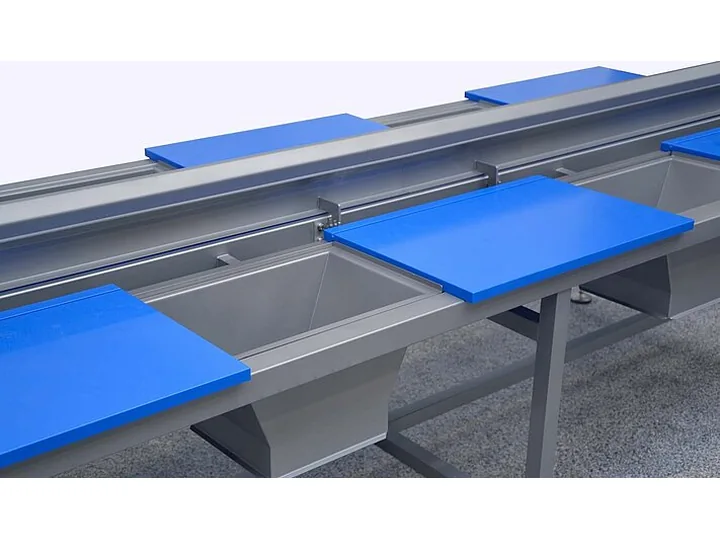
01 · Give people a clear preparation station
The boards support manual trimming and the centre channel separates removed material from prepared product. The pictured detail is one configurable arrangement. Agree operator positions, raw-product storage, waste removal and the hand-off to the cutter; this is not an automatic trimming robot.
Set the standard for damaged outer leaves, stem ends and any core removal required by the recipe. A preparation table provides a workable place to do this, but the operator still makes the trim and quality decisions. Keep prepared product and discarded material on clearly assigned paths.
Compare the workstation: reach, board arrangement, knife handling, lighting, waste chutes, crate position and transfer height. Request the required cleaning and safe-work procedures. Avoid designing the line around the number of operators in a catalogue photograph.
Cutting: choose leaf size and quality before choosing speed
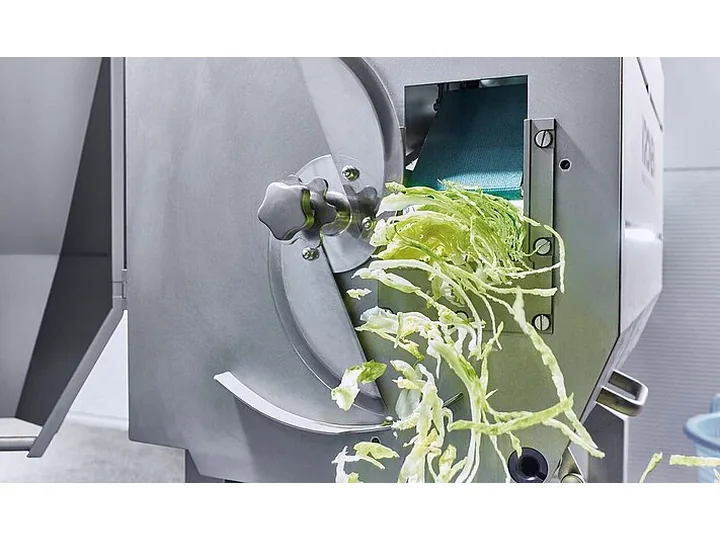
02 · See the cut where it happens
A belt cutter feeds prepared lettuce to the selected cutting tool. This close-up shows the product and cutting action rather than a decorative food photograph. Strips, larger pieces and whole leaves are different output briefs: the right tool and feed arrangement need a lettuce trial.
A belt cutting machine such as GS 10-2 is a reference for prepared-lettuce cutting. Agree whether you need strips, larger salad pieces or another supported cut. Leaves intended to stay whole may bypass the cutter. Confirm the exact tool, product guide and feed setup for the lettuce being processed.
Judge actual output: cut-size distribution, torn edges, crushed ribs, fines, retained whole pieces and usable yield. Include soft leaves and the firmest material expected in production. Assess quality again after washing, dewatering and the intended holding period, rather than judging only the first cut sample.
Washing: match contact, water management and discharge
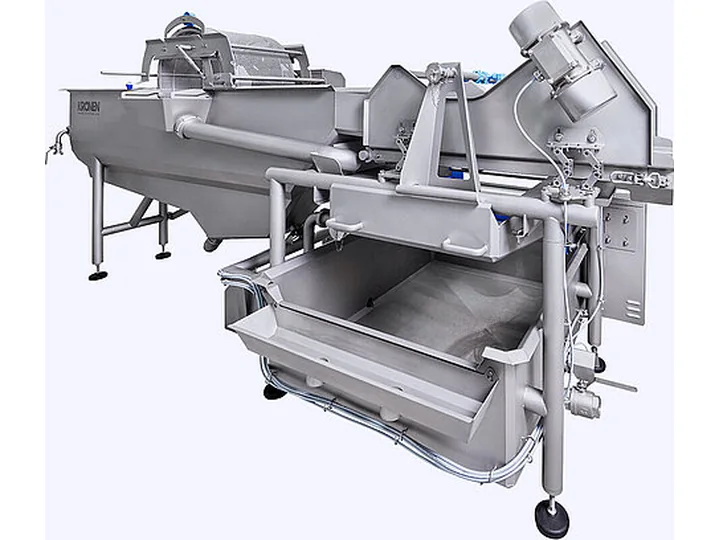
03 · Follow the leaves through the water path
HEWA is a water-based washing example with vibration or belt-outfeed options. Match the inlet, leaf movement, floating and sinking debris removal, water circuit and discharge to the prepared lettuce. Washing and surface-water removal are separate duties.
Compare the product path through the washer, debris removal and the management of process water. A gentle-looking water flow is not by itself evidence of a validated cleaning or hygiene result. Confirm the actual lettuce form, inlet load, wash contact and outfeed arrangement with the responsible process team.
The HEWA reference and the KRONEN processing-line example show different arrangements; do not treat their components as one automatically matched package. Where a rinse or a treatment step is specified, give it its own duty and acceptance criteria.
Ask to inspect: leaf accumulation, floating debris, heavy contamination removal, water carry-over, access beneath and around the outfeed, drainability and the cleaning procedure. No universal chemical concentration, water temperature, contact time or microbial-reduction claim is specified here.
Sorting: separate incoming selection from final-product inspection
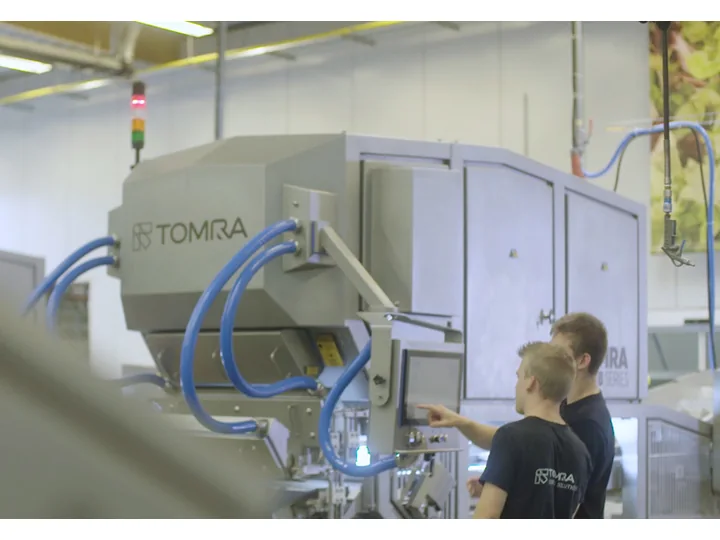
04 · Define what to keep and what to reject
TOMRA lists 5B for leafy-greens sorting. This equipment photograph identifies the machine family; it does not establish a tested lettuce configuration. Confirm product presentation, the installed sensors and the precise reject criteria with the supplier.
Manual selection can remove visibly damaged heads or leaves at receiving and preparation stations. Optical sorting is a separate equipment duty for a suitable product stream. Decide what needs to be detected, how lettuce is spread for inspection and where rejects go.
For a sorter such as TOMRA 5B, agree the lettuce format and the intended process position. Ask the supplier to demonstrate the configured defect and foreign-material categories using an agreed challenge set. Inspect accepted product as well as rejects to measure missed defects and good-leaf loss.
Do not infer universal detection or whole-head suitability from a leafy-greens category page. Whole heads, loose leaves and wet cut pieces need separately confirmed handling. Optical sorting does not replace every hygiene or inspection control.
Dewatering: remove free water, retain useful leaves
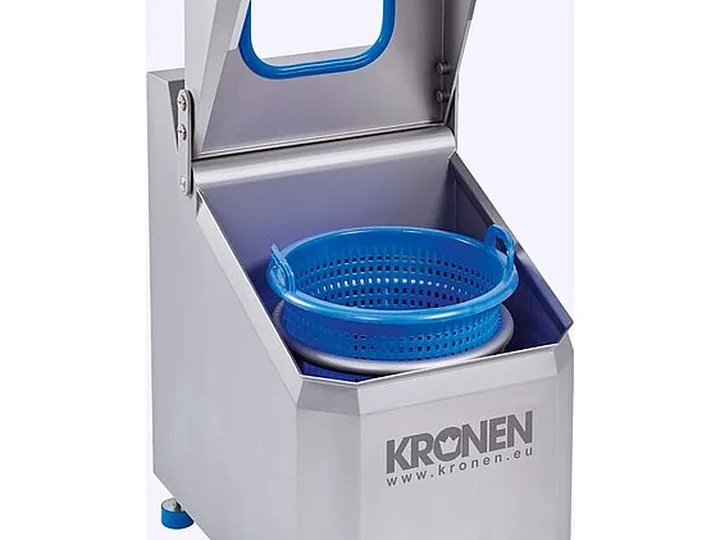
05 · Remove surface water without crushing the leaves
The perforated basket illustrates batch centrifugal dewatering. Compare basket filling, loading, unloading and cleaning as part of the cycle. This view is a basket detail, not a complete-machine installation photograph or proof of a particular lettuce load.
Drainage or vibration outfeed removes some water; a centrifugal step performs a different duty. In a basket spinner, batch mass and volume, distribution, program and leaf condition affect the result. A conveyor-fed arrangement changes feeding and discharge again. Compare the complete operation, not just the closed-lid spinning time.
| Arrangement | What moves | What to verify |
|---|---|---|
| Drain or vibration outlet | Wet product leaves the wash stage while water drains away. | Carry-over water, leaf retention, accumulation and transfer to the next duty. |
| Batch basket spinner | Product is loaded, spun in a basket and unloaded. | Load distribution, remaining surface water, leaf damage, handling effort and basket cleaning. |
| Conveyor-fed dewatering | A configured system coordinates feeding, water removal and discharge. | Product continuity, start/stop behaviour, damage and access for cleaning. |
Agree an assessment method for remaining free water, drainage after holding, leaf condition and pack presentation. Water removal is not sterilisation, cooking or proof of microbiological safety. No universal speed, cycle time or acceptable moisture figure is inferred from the photograph.
Packaging: dose gently and keep leaves out of the seal
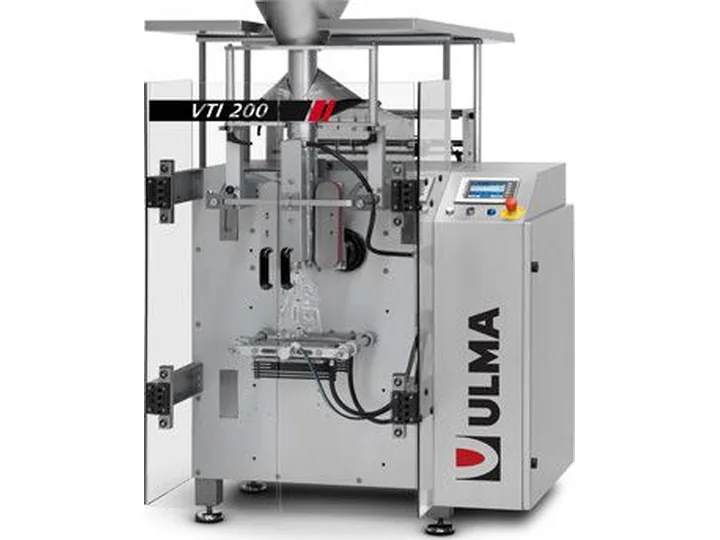
06 · Match the bagger to a controlled leaf feed
ULMA links VTI 200 to a cut-salad and baby-leaf VFFS application. The wrapper forms and seals the film; dosing or weighing, product feeding and the final pack specification remain separate decisions. Do not assume the pictured standard configuration includes every MAP option.
Whole heads: compare a suitable flow wrapper, bag or tray arrangement with the buyer. Check head size variation, support, orientation, film requirements, label location and protection during transport. ULMA publishes a separate whole-lettuce flow-wrapping application.
Prepared leaves: a vertical form-fill-seal wrapper can be considered alongside suitable tray or pouch systems. Control dosing, leaf drop, bridging in the forming tube, water carry-over and product caught in the seal. The VTI 200 application is a machine/format reference, not an independently tested lettuce performance result.
If MAP is required, specify gas handling, film and package design as part of the actual product process. Do not assume every bagger provides the same atmosphere functions. Agree seal checks, coding, net-weight control, cooling and distribution conditions; no gas mixture or shelf-life promise is given here.
Watch product transfers, then inspect cleaning access
The first official film explains one connected alternative; the second looks more closely at washer feeding, discharge and access. Both have English viewing notes, so the guide remains useful without playing a video.
Follow a lettuce preparation line
Use this short official film to understand product movement between cutting, washing and downstream handling. The connected arrangement is an alternative to the separate equipment references above.
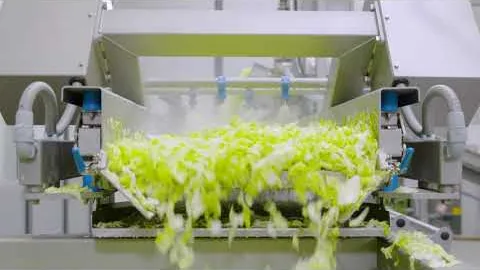 Watch on YouTube ↗ · 1:38
KRONEN Food processing · Official manufacturer footage
- Around 0:22: read the manufacturer’s layout diagram, locate the GS 10-2 and GEWA labels and follow the connecting conveyors. Compare the arrangement with the separate machine references in this guide.
- Around 0:55: observe cut lettuce moving in the wash water. Ask how your line controls leaf contact, debris and product carry-over.
- Around 1:05: follow the conveyor hand-off into the next treatment stage. Compare this arrangement with the removable-basket handling illustrated in the KS-100 PLUS photo.
The current KRONEN line page labels this an alternative processing-line demonstration. The film’s title contains a promotional output figure; it is not adopted here as a tested line capacity. The film does not establish that all pictured standalone references form that exact line.
Look inside the wash and cleaning-access arrangement
This second film answers a different question: how a HEWA washer is fed, how washed leaves leave it and what becomes accessible for cleaning.
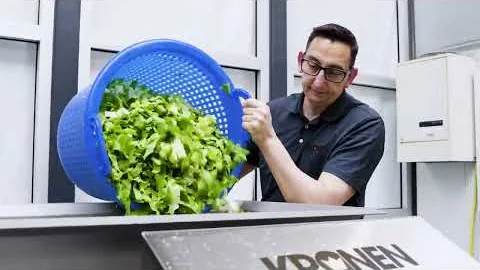 Watch on YouTube ↗ · 2:33
KRONEN Food processing · Official manufacturer footage
- Around 1:01: watch lettuce being tipped into the washer and consider loading height and spill control.
- Around 1:16: follow leaves at the vibration outfeed and into collection baskets; include basket exchanges in the work cycle.
- Around 2:09: inspect the opened machine and washdown access. Ask to see the supplier’s documented cleaning and safe-access procedure.
Official HEWA 3800 demonstration with original English viewing notes supplied here. The footage explains one configuration; it is not a validated microbial-reduction test, operating recipe or shelf-life result. Automatic captions are not used as technical evidence.
Specify a lettuce trial that covers all six duties
- Define the incoming lettuce. Record variety/form, head or leaf size, firmness, temperature history and realistic contamination or damage variation.
- Agree the product standard. State trimming, whole-leaf or cut format, acceptable damage, free-water assessment and the final pack sample.
- Follow saleable output. Measure product after all required handling, including waste, fines, quality rejects, rework and packaging rejects.
- Include transfers and stops. Test basket exchanges or continuous feeding, downstream interruption, restart and product accumulation.
- Make cleaning part of the offer. Assign water circuits, waste removal, access, tools, drainage, cleaning procedures, utilities, commissioning and training.
Questions before choosing the line
Does whole lettuce need the same cutter and spinner as fresh-cut leaves?
No. A whole-head brief normally retains the head structure. Cutting and centrifugal handling must be selected for the actual product form; loose-leaf references do not prove whole-head suitability.
Should lettuce be cut before washing?
The prepared-leaf example uses trimming and cutting before a downstream wash. The actual process may also require pre-cleaning or a different sequence. Agree the full route with the process team rather than treating one demonstration as a universal recipe.
Does a washer or optical sorter make the product ready to eat?
No ready-to-eat or shelf-life claim follows from a machine purchase. Product handling, hygiene controls, validation, packaging and distribution conditions must be assessed together.
How should quotes be compared?
Use the same lettuce and finished-product brief. Compare the complete installed route, operator tasks, utilities, cleaning, tools, commissioning, support and the agreed acceptance trial.
Sources, image credits and review scope · 2 November 2026
Images are attributed manufacturer equipment references. The trimming, cutting, washer and basket photographs show different duties; the sorter photograph is not a lettuce trial, and the bagger is a studio reference. No image or film is presented as a Food Machinery IQ installation. Supplier inclusion is permanently free; source addresses are plain text.
- KRONEN: configurable trimming tablehttps://www.kronen.eu/en/solutions/trimming-table-for-4-people
- KRONEN: GS 10-2 belt cutting machinehttps://www.kronen.eu/en/solutions/belt-cutting-machine-gs-10-2
- KRONEN: HEWA 3800 washing machinehttps://www.kronen.eu/en/solutions/hewa-3800-washing-machine-with-vibration-or-belt-outfeed
- KRONEN: KS-100 PLUS lettuce and vegetable spin-dryerhttps://www.kronen.eu/en/solutions/vegetable-and-lettuce-spin-dryer-ks-100-plus
- KRONEN: lettuce processing line and alternative demonstrationhttps://www.kronen.eu/en/solutions/processing-line-for-lettuce-vegetables-and-fruit
- TOMRA: leafy-greens sorting applicationshttps://www.tomra.com/food/categories/vegetables/leafy-greens
- TOMRA: 5B belt sorterhttps://www.tomra.com/food/machines/tomra-5b
- ULMA: cut-salad and baby-leaf VFFS applicationhttps://www.ulmapackaging.com/en/packaging-solutions/produce/fresh-vegetables-without-tray/cutted-salads-and-spinach-baby-leaves-packaging-in
- ULMA: VTI 200 vertical wrapperhttps://www.ulmapackaging.com/en/packaging-machines/vertical-vffs/vti-200
- ULMA: whole-lettuce flow-wrapping applicationhttps://www.ulmapackaging.com/en/packaging-solutions/produce/fresh-vegetables-without-tray/lettuce-packaging-in-flow-pack-wrapper-hffs
- ULMA: produce packaging formatshttps://www.ulmapackaging.com/en/packaging-solutions/produce
Official channel identities and useful film scenes were checked. Catalogue photographs and older demonstrations explain equipment choices, not independently verified capacity, yield, detection, certification or shelf life. Current signed specifications and a product trial remain the basis for procurement.