Equipment guide · Vacuum shrink packaging
Three ways to shrink a sealed food pack
A hot-water shrink machine tightens a compatible shrink bag or film around an already sealed product. Choose the handling method first: bring packs to a lifting platform, feed an automatic immersion station, or convey them through a continuous spray tunnel.
For meat, cheese, fish and other suitable packed foods, the useful comparison is the complete path from vacuum sealing to a dry, inspectable pack. The examples below are a starting point for a product trial, not a manufacturer ranking.
See the difference before comparing specifications
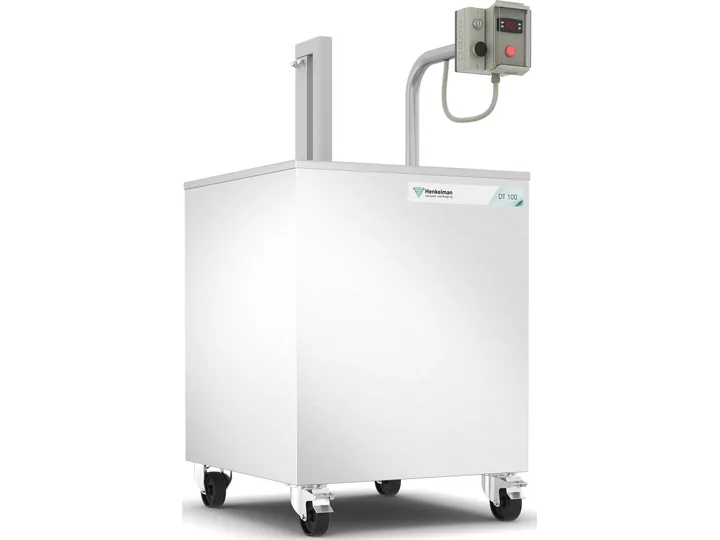
01 · Manual-load dip tank
The operator brings each sealed pack to a platform. The lift handles immersion; loading and removal remain separate tasks. Start here when batches arrive intermittently.
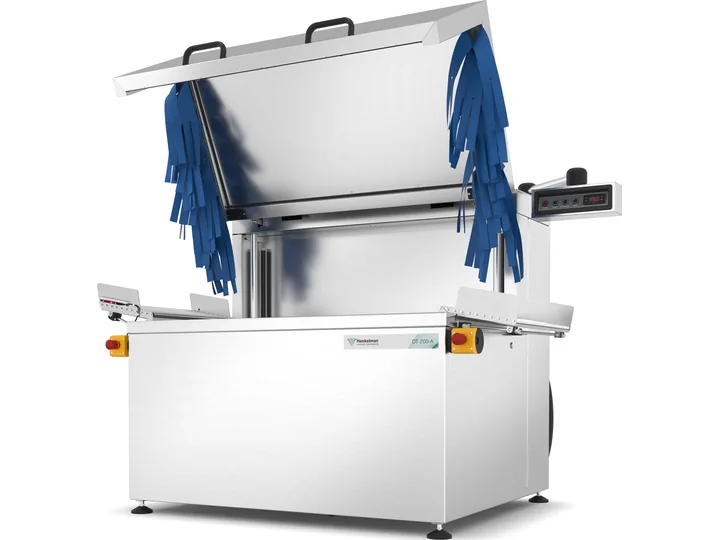
02 · Automatic immersion machine
A conveyor-fed platform links shrinking to vacuum packing. Compare hand-off, batch spacing and discharge as carefully as the tank itself.
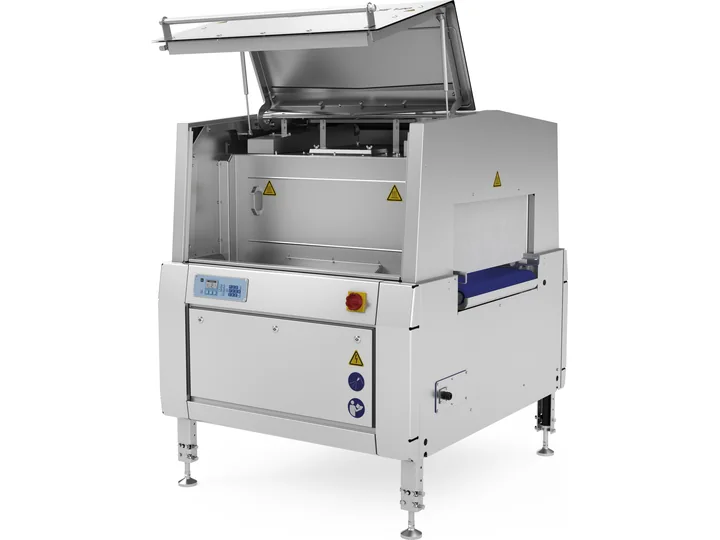
03 · Continuous hot-water tunnel
Packs travel through a hot-water spray zone. MULTIVAC also lists the wider SE 135. Confirm the transport arrangement for flat, rolling or floating packs.
Images are attributed manufacturer product references for the named equipment, including studio-style presentations. They are not photographs of equipment owned, built or independently tested by Food Machinery IQ.
Watch the handling sequence
Open the official clips on YouTube. Each includes English viewing notes below; this page remains usable without playing them.
See the lift-and-dip cycle
Use this short demonstration to understand the physical sequence of an operator-loaded tank.
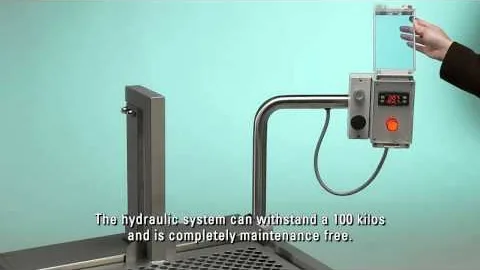 Watch on YouTube ↗ · 0:57
Henkelman Vacuum · Official manufacturer footage · Checked 1 November 2026
- Opening: locate the controls and the raised perforated platform.
- About 0:34–0:51: follow the packs through immersion and return above the water.
- Compare with your layout: decide where sealed packs wait and where wet packs go next.
This is older DT60 footage with English on-screen text. Use it to understand the mechanism; confirm current loading limits and safeguards from the current model documentation, rather than historic promotional captions.
Follow an automatic vacuum-to-shrink line
This second clip answers a different question: how sealed packs move from a double-chamber vacuum machine into an automatic dip tank.
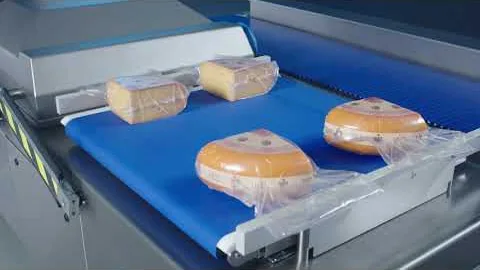 Watch on YouTube ↗ · 1:09
Henkelman Vacuum · Official manufacturer footage · Checked 1 November 2026
- First half: identify the chamber machine and the separate transfer conveyor.
- Second half: at about 0:34, identify the separate shrink station and its transfer connection; compare this with the chamber and conveyor views around 0:20 and 0:51.
- For your trial: request the same sequence with your pack size and batch spacing, including a downstream stop.
Henkelman manufacturer demonstration with English on-screen explanations. It shows one configured line, not an independently measured capacity test or proof that every pack format will transfer reliably.
Other configurations worth comparing
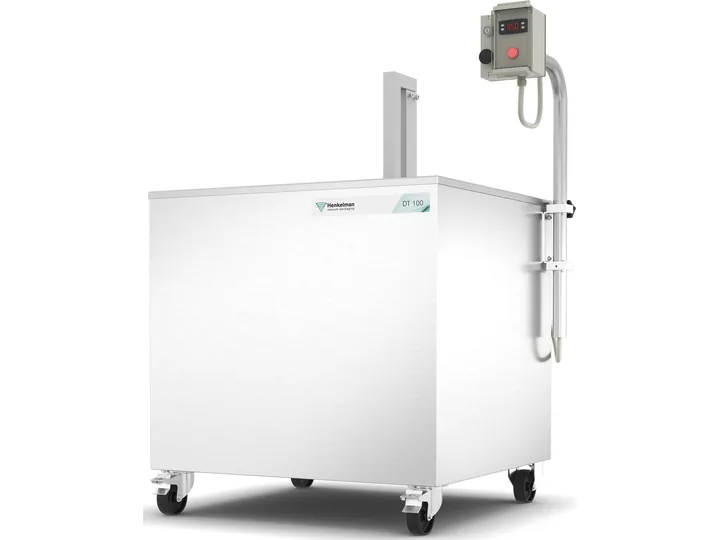
More platform space
The published chamber dimensions are 600 × 800 × 220 mm, compared with 500 × 600 × 220 mm for DT60. Check the loaded pack envelope and handling reach.
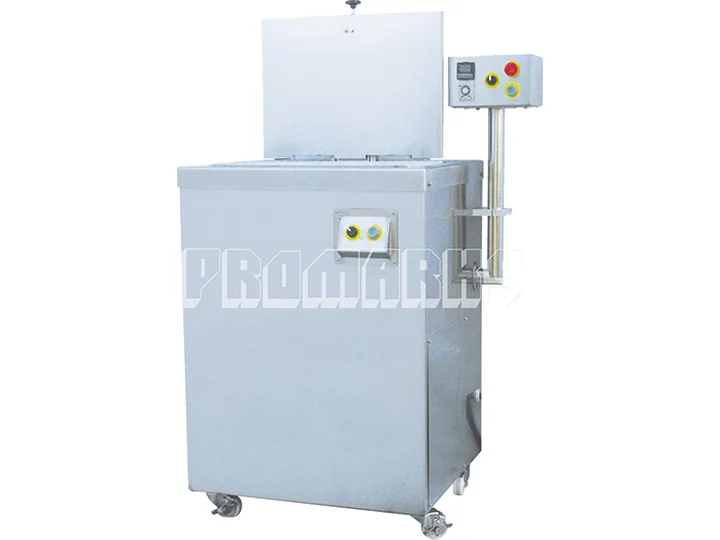
Powered lift, operator loading
Promarks lists adjustable platform timing, semi-automatic/automatic mode selection and a low-water warning with heating stop. Confirm what the operator still handles in the offered configuration.
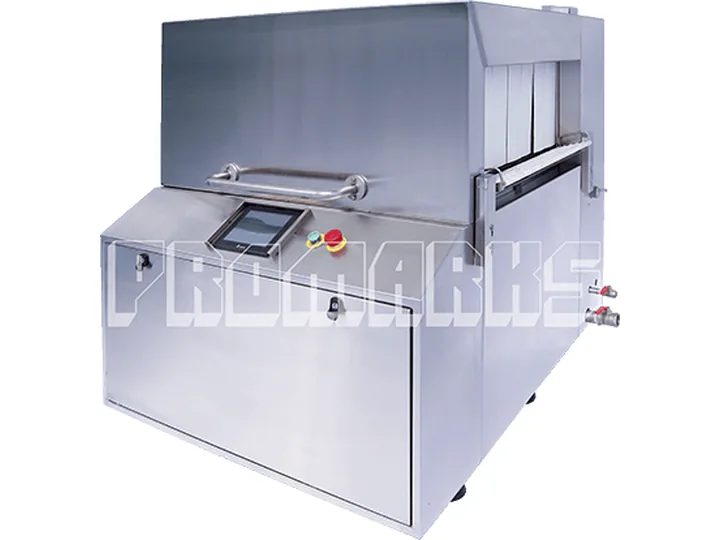
Automatic feed and discharge
The published configuration includes automatic infeed/release, PLC control and water filling. Its machine cover opens for cleaning access. Confirm the interface with the vacuum machine.
Swipe the table horizontally on a narrow screen.
| Configuration | Published model examples | What to check in a trial |
|---|---|---|
| Manual-load powered dip | Henkelman DT60 / DT100; Promarks ST-10; MULTIVAC SE 60 | Hand loading, full immersion of the pack, lifting clearance and removal of wet packs. SE 60 is listed as mobile and without a compressed-air requirement. |
| Automatic immersion | Henkelman DT200A; Promarks ST-68; MULTIVAC SE 320 / SE 335; BOSS ATT 1080 / ATT 1600 | Transfer height, product spacing, platform occupancy, stop signals and discharge. BOSS describes automatic basket immersion; agree the complete conveyor scope in the offer. |
| Continuous hot-water spray | MULTIVAC SE 120 / SE 135 | Pack support, spray exposure, belt transfers and the space needed for upstream transport and downstream drying. |
Model names identify published examples, not interchangeable machines. A larger tank is not automatically a faster line. A switch marked “automatic” may automate a dip cycle while still leaving pack loading to an operator.
Specify the pack before the machine
- Bring the actual sealed product. Record its largest dimensions, mass, shape, bag tail and seal position. Include difficult examples: light, floating, flat, rounded or irregular packs. Ask the supplier to demonstrate how they stay supported.
- Agree the film and seal. Give the film supplier the exact bag or film construction and food application. Confirm its approved shrink window and the sealing process before setting water temperature or exposure time.
- Measure complete output. Count accepted packs after transfer, shrinking, draining and inspection. Include replenishment, stops, cleaning and rejects. Keep immersion time separate from full machine cycle time.
- Plan the wet exit. Decide whether draining alone is sufficient or a drying unit is required before labels, checkweighing or cartons. Test label adhesion and retained water with the actual pack geometry.
- Check the room. Obtain the installation drawing, connected electrical load and supply, water quality and filling needs, drain requirements, vapour extraction, access for cleaning and any compressed-air requirement for the exact model.
No universal temperature, dip time, shelf-life or food-safety result is specified here. Agree settings with the film and equipment suppliers and validate the packaged product in its intended process and distribution conditions.
A useful acceptance trial
Run the agreed product mix through start-up, normal production, a format change and a controlled downstream stop. Record incomplete shrink, trapped folds, leaking seals, damaged packs, transfer failures, residual water and rejected packs against agreed criteria. Check the documented hot-water, moving-platform, low-water and cleaning safeguards during commissioning with the responsible supplier.
Questions that change the buying decision
Is a shrink tank also a vacuum sealer?
The stages are different. The pack is evacuated and sealed upstream, then exposed to hot water to shrink compatible film. Specify the vacuum machine and shrink station separately, including who supplies their transfer interface.
Can any vacuum bag go into the tank?
Choose material specifically approved for the intended shrink process and food use. Ordinary vacuum-bag appearance does not establish hot-water shrink suitability. Obtain the material specification and trial the sealed pack.
Is this the same as a hot-air or steam shrink tunnel?
This guide covers water immersion and hot-water spray. Hot-air and direct-steam equipment use different heat-transfer arrangements. Also distinguish packaging shrink duty from cooking, pasteurisation or retort processing.
What should a price comparison include?
Request dated offers for the same product brief. Compare tank or tunnel, conveyors, dryer, extraction, installation, commissioning, training, spare parts and the utility work required at your site. A bare machine price is not the installed line cost.
Where to look for useful improvements
Current manufacturer examples suggest three practical development directions: reducing manual transfers with coordinated feeding and discharge; making covers and product paths easier to access for cleaning; and matching shrink, drying and labelling as one handling problem. These are editorial observations from the listed configurations, not a measured market-growth forecast.
Ask bidders to demonstrate the benefit with your packs. Compare accepted output, labour tasks, water and energy use over an agreed run rather than inferring savings from heater rating or an edited video.
Manufacturer sources and review limits · 1 November 2026
Source addresses are plain text. Models and features are manufacturer-published descriptions, not independent performance verification. Inclusion is permanently free.
- Henkelman: Diptank model familyhttps://henkelman.com/en/products/dip-tanks/diptank
- MULTIVAC: current shrinking and drying unitshttps://multivac.com/int/en/our-solutions/portfolio/packaging-solutions/shrinking-and-drying-machines
- Promarks: ST-10https://www.promarks-vac.com/st-10-hot-water-shrink-tank.html
- Promarks: ST-68https://www.promarks-vac.com/st-68-hot-water-shrink-tank.html
- BOSS: ATT 1080 and ATT 1600 automatic tank serieshttps://www.vacuum-boss.com/en/media/news/new-automatic-shrink-tank-series-186
- Official regional Henkelman video cataloguehttps://www.henkelman.es/videos/
The current MULTIVAC page lists SE 60, SE 320/335 and SE 120/135. Older SE 115/130 catalogue references were not treated as current model recommendations. Henkelman source tables and older promotional footage use different cycle/load presentations; confirm the current signed specification instead of combining them. No comparative prices, certified performance, warranty or availability claims are made.