Crop guide · Spinach preprocessing
Keep the leaf whole—or define the cut before building the line
Baby spinach sold as intact leaves and mature spinach prepared for cooking need different handling. This guide covers washing, trimming, cutting, sorting, dewatering and packaging, with equipment references and official working footage. Not every route needs every machine.
Two fresh-product routes
Intact baby leaves
Receive and inspect loose leaves → select and trim only where required → wash under the specified process → inspect/sort at the agreed point → remove surface water → dose and pack.
Preserve the leaf. A cutter is normally bypassed when intact leaves are the product. Tender leaves need a trial that includes transfers and water removal, not just the washer.
Prepared mature spinach
Receive loose or bunched spinach → remove ties and unwanted root/stem material as applicable → optional pre-cleaning and cutting → washing and inspection → dewatering → packaging for the agreed use.
Define what stays. Rooted bunches, long stems and detached leaves are different feed conditions. Set the cut and line order with the process team. Blanching, cooking, freezing and IQF packing require additional stages outside these fresh-product routes.
Trimming: prepare the actual incoming spinach
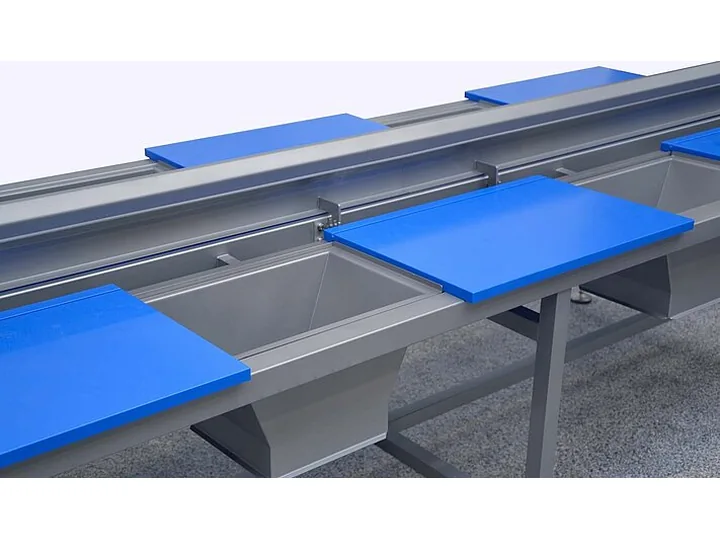
A preparation table with a separate waste path
A manual station provides boards, product support and a waste chute. Operators still decide which leaves, roots or stem portions to remove. Specify the station around the actual incoming spinach: loose baby leaves need different preparation from mature bunches with attached roots.
Agree the acceptance standard for roots, long or coarse stems, damaged leaves, ties and other incoming material. Baby leaves do not need an iceberg-lettuce coring machine. Mature spinach may need manual root-end trimming or a confirmed mechanical arrangement; a general preparation table is not evidence of automatic root removal.
Look at the work: crate handling, reaching, lighting, tool storage, waste removal and the hand-off to the next duty. Include the required hygiene and safe-work procedures. Keep trim waste from returning to prepared product.
Cutting: an optional stage with a specific output
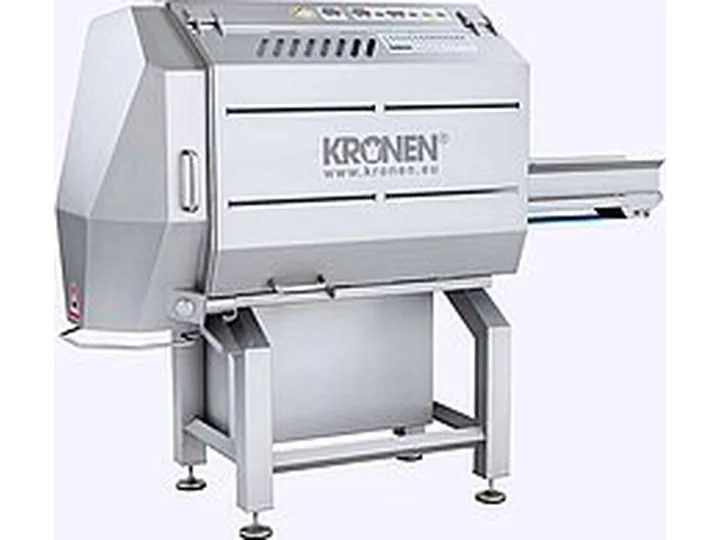
A belt cutter for the cut-product route
The belt guides prepared product toward the cutting tool. This reference illustrates the machine layout, not a proven spinach cut or a supplied blade set. Define the intended leaf and stem pieces first; then ask the supplier to confirm tooling, feeding and output quality with your spinach.
For cooking ingredients, ask whether the recipe needs leaf strips, stem lengths or another prepared form. Specify the mixture of leaves and stems, how bunches will be opened and how product reaches the belt. Confirm the cut with an actual sample rather than adopting a general vegetable-cutter claim.
Judge the finished sample: size variation, torn edges, crushed stems, fines and useful yield. Follow the sample through washing and dewatering too. A neat cut at the knife can still become a poor packed product after several rough transfers. Intact baby-leaf packs normally bypass this duty.
Washing: clean the leaf stream and manage the water
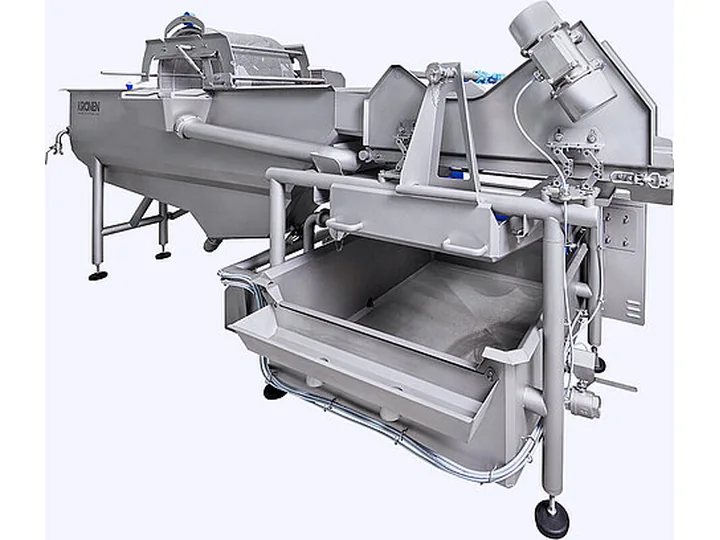
A water path designed around loose leaves
HEWA is a washing-machine example for leafy products, including spinach. Compare entry into the water, leaf circulation, debris separation and discharge. The washer is a process stage; it does not by itself establish a ready-to-eat specification.
Loose leaves can float, overlap and carry soil or other field material. Compare how the washer wets and separates the actual spinach, removes debris and delivers leaves to the next stage. Sormac also lists its PULSTAR range for delicate leafy greens; it is an alternative supplier reference, not another name for HEWA.
Inspect the whole circuit: inlet loading, circulation, sand/soil separation, screens, water replacement or treatment, drainage and product carry-over. Ask how a changing incoming load is controlled. Do not turn gentle-looking agitation into a claim of validated microbial reduction.
Where pre-washing, rinsing or a treatment stage is required, give each its own purpose and acceptance checks. There is no universal chemical concentration, contact time or water temperature in this guide. The responsible process team must establish the product's hygiene requirements.
Sorting: define defects, presentation and reject handling
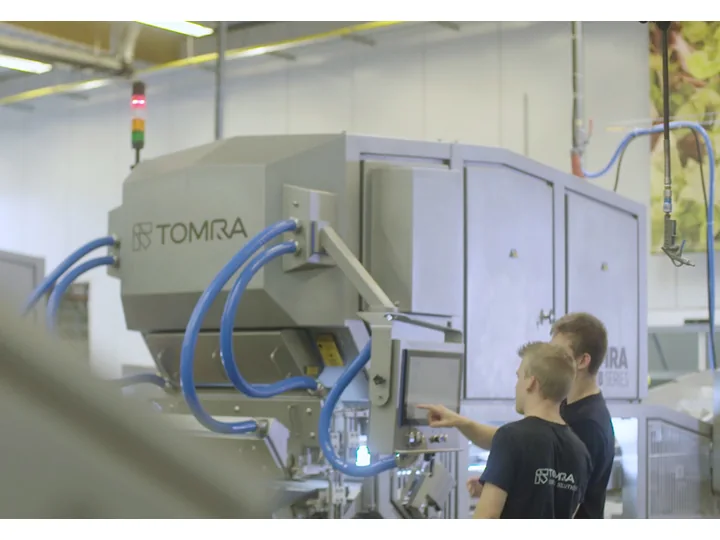
An optical sorter needs a defined challenge set
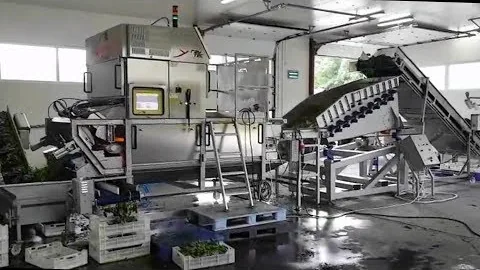
TOMRA lists spinach and baby spinach among 5B applications. The picture identifies the equipment family. Installed sensors, product spread, reject settings and the position in the line need confirmation for the actual leaf stream. The Raytec film below shows a different supplier and machine.
Start with manual incoming selection and preparation. Optical sorting adds a separate duty for a suitably presented product stream. Define unwanted leaf condition and foreign-material categories, then ask the supplier to demonstrate the offered configuration with a controlled challenge set.
Compare both streams: inspect accepted spinach for missed material and rejects for good-leaf loss. Record the actual leaf size, wetness, overlap and feeding conditions. Washed fresh spinach and frozen product are different applications; do not apply the result from one to the other.
The short Raytec SPRAY film below helps explain feed and collection. It does not prove that SPRAY and TOMRA 5B have identical sensors, reject mechanisms or performance. No sorter is presented here as a replacement for every hygiene or inspection control.
Dewatering: remove free water without losing the leaf
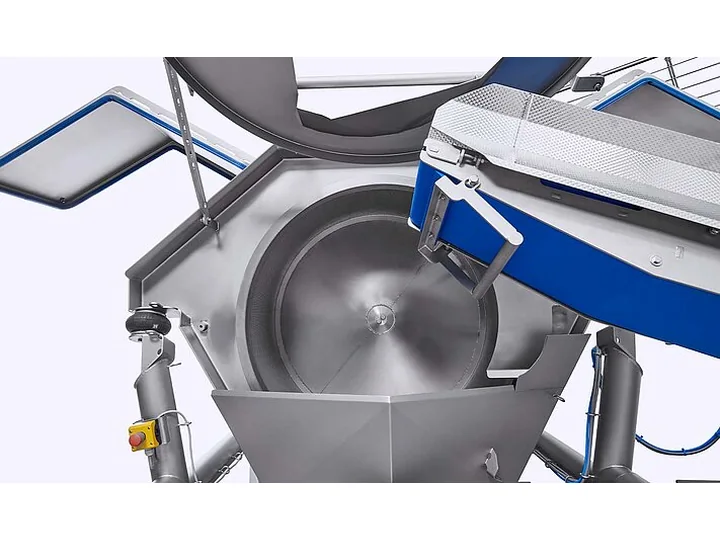
Conveyor-fed centrifugal dewatering
A horizontal centrifuge combines product feeding, a spinning cycle and discharge. K1040H is a current reference with a buffer in its infeed conveyor. Continuous line feeding does not mean the drum has no cycle. Review leaf loading, transitions, discharge and safe cleaning access together.
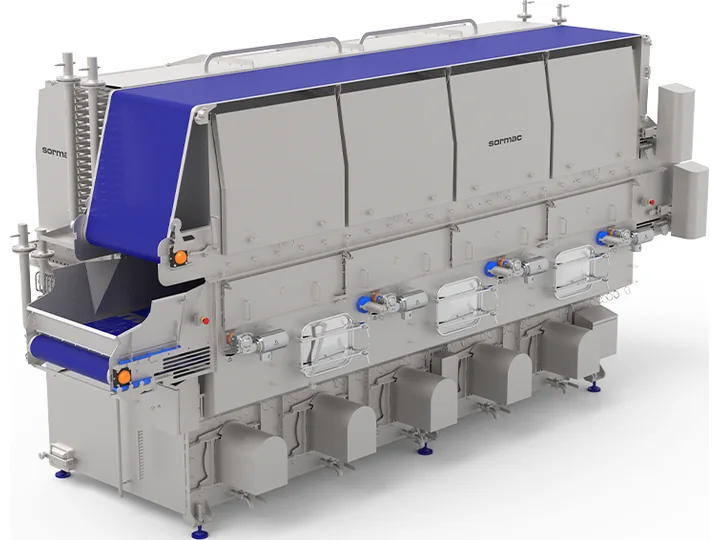
Air drying is a separate option to compare
An air-drying tunnel offers a different approach to removing water from delicate leaves. Sormac describes thermal treatment followed by a cooling section. Compare temperature history, air handling, residence time, leaf condition and exit temperature; do not assume it is a drop-in equivalent to a spinner.
First distinguish drain-down from the final water-removal duty. A draining or vibration outlet can remove carry-over water, while a centrifuge or air tunnel changes the product again. Compare the complete route, including how spinach is fed, collected and moved into the packer.
| Arrangement | What it does | What to compare with spinach |
|---|---|---|
| Drain or dewatering conveyor | Separates some water during transfer after washing. | Leaf retention, pooling, distribution and carry-over to the next machine. |
| Batch or automatic centrifuge | Spins product in a basket or drum; feeding and discharge depend on the system. | Loading pattern, full cycle, leaf damage, remaining free water and cleaning access. |
| Air-drying tunnel | Uses a controlled air-treatment path; the LDT example includes cooling. | Air and leaf temperature, residence time, leaf loss, water removal and packaging temperature. |
Agree how to assess remaining surface water, bruising, useful yield and drainage after holding. Check different incoming spinach conditions. A dry-looking surface does not prove sterility, cooking or readiness to eat. No universal speed, time, moisture target or energy comparison is inferred from these references.
Packaging: control the dose, the drop and the seal
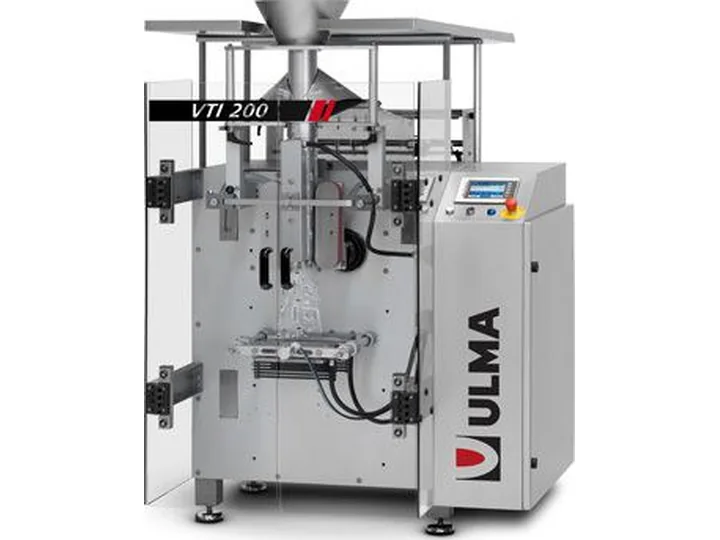
Form the pack around a controlled spinach dose
ULMA links VTI 200 to its cut-salad and baby-spinach application. The wrapper forms and seals a bag. Weighing, dosing, transfer into the forming tube, gas handling and downstream checks must be specified as part of the complete installation.
For loose fresh leaves, compare a vertical bagger with the required weighing and feed system, or another pack format selected for the buyer. Bunched spinach needs a separate handling and wrapping brief; the baby-leaf VFFS reference does not establish bunch compatibility.
Watch the product: bridging above the dose point, compression, the fall into the bag, water in the seal area and leaves trapped across a sealing jaw. Include net weight, coding, seal inspection, conveying and transport protection in the trial.
If modified-atmosphere packaging is required, specify the actual gas equipment, film, pack geometry and distribution conditions with the process and packaging teams. A catalogue's MAP application is not proof that every standard machine includes the same options. No atmosphere recipe or shelf-life promise is adopted here.
Watch the leaf transfers and the sorting installation
The first film follows dewatering and access; the second shows spinach sorting. Both open on the official YouTube watch page and have English viewing notes. The written guide remains complete without playing them.
Follow spinach through a horizontal drying system
See how a connected washer and horizontal centrifuge move product between stages. The film includes iceberg lettuce, spinach and diced onions; use the spinach section when comparing leaf handling.
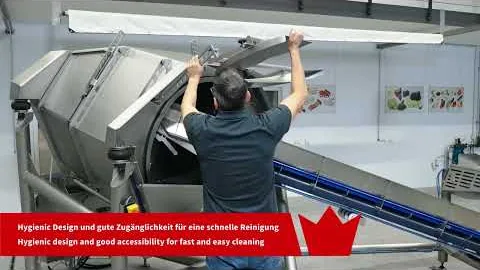 Watch on YouTube ↗ · 1:42
KRONEN Food processing · Official manufacturer footage
- Around 0:22: the pale cut product is iceberg lettuce, not spinach. Note the product change before judging suitability for your leaf.
- Around 0:44: follow spinach leaves across the transfer to the blue conveyor. Look at the drop, leaf distribution and any collection points.
- Around 1:25: examine the opened enclosure and the conveyor moved away from the drum. Include safe isolation, opening and cleaning procedures in the equipment brief.
External K1040H demonstration from KRONEN. It explains one connected configuration, not a measured spinach capacity, residual-water result or shelf-life test. It is not footage of the Sormac air tunnel shown above.
See the feed and collection around a spinach sorter
This short SPRAY demonstration shows spinach moving through a sorting installation. It adds a view of the feed and collection arrangement to the written sorting brief.
 Watch on YouTube ↗ · 0:42
Raytec Vision · Official manufacturer footage
- Opening seconds: locate the inclined feed conveyor, enclosed sorter and outgoing collection paths.
- Around 0:05: inspect the leaf feed close to the machine. Ask how leaf overlap and bunches are controlled in your configuration.
- Around 0:22: inspect the collected leaves and surrounding transfer area. Evaluate both accepted and rejected product in an agreed trial.
Official Raytec Vision film published in 2018. SPRAY is a different machine from the TOMRA 5B photograph. Collection footage does not identify every reject or establish detection accuracy; verify the current offered model and sensor package. Captions are unavailable, so these original English watch points provide the viewing context.
Prepare a trial around saleable spinach
- Define the raw material: baby or mature leaves, loose or bunched, attached roots/stems, size, temperature history and realistic incoming variation.
- Provide a finished-product sample: intact leaves or specified cuts, trim standard, surface-water assessment and final package.
- Measure after the full route: include trim loss, fines, sort rejects, leaf damage, rework and rejected packs.
- Include interruptions: check startup, buffering, basket changes where applicable, downstream stops and restart.
- Include the working day: cleaning access, drains, waste handling, utilities, staffing, changeovers, commissioning and acceptance checks.
Questions before selecting the line
Does baby spinach need to be cut?
Usually not when the specification is intact leaves. Cutting is a separate, optional duty for the required prepared product. Choose it from the finished-product brief, not simply because a line has a cutter.
Can the same water-removal setting serve every leaf?
Do not assume so. Leaf condition, size, load and preceding treatment vary. Compare surface-water removal and damage using actual spinach across the full handling cycle.
Does a fresh-spinach line also make frozen spinach?
The six duties here describe fresh preprocessing and packing. Frozen products need a separately specified downstream route, potentially including thermal processing, cooling, freezing and a suitable frozen-product packing system.
Do washing and MAP make spinach ready to eat?
Machine selection alone does not establish that claim. The complete process, hygiene controls, validation, packaging and distribution requirements must be assessed together.
Sources, image credits and review scope · 2 November 2026
Images are attributed manufacturer equipment references. The preparation, cutter, washer, sorter and open-centrifuge photographs explain separate duties; the air tunnel and bagger are studio references. They are not Food Machinery IQ installations or proof of spinach acceptance results. Supplier inclusion is permanently free. Supplier source addresses appear as plain text.
- KRONEN: configurable trimming workstationhttps://www.kronen.eu/en/solutions/trimming-table-for-4-people
- KRONEN: GS 10-2 belt cutterhttps://www.kronen.eu/en/solutions/belt-cutting-machine-gs-10-2
- KRONEN: HEWA 3800 washing machinehttps://www.kronen.eu/en/solutions/hewa-3800-washing-machine-with-vibration-or-belt-outfeed
- KRONEN: K1040H horizontal drying systemhttps://www.kronen.eu/en/solutions/k1040h-horizontal-drying-system
- Sormac: leafy greens and spinach processinghttps://sormac.com/en-us/leafy-greens-processing
- Sormac: PULSTAR washer rangehttps://sormac.com/en-us/machines/lettuce-washer-pulstar-range
- Sormac: LDT-100 air drying tunnelhttps://sormac.com/en-us/machines/air-drying-tunnel-ldt100
- TOMRA: industrial spinach sortinghttps://www.tomra.com/en-gb/food/categories/vegetables/industrial-spinach
- TOMRA: 5B sorterhttps://www.tomra.com/food/machines/tomra-5b
- Raytec Vision: SPRAY spinach demonstrationhttps://www.raytecvision.com/youtube-video/spray-sorting-machine-for-spinach-raytec-vision-spa/
- ULMA: cut-salad and baby-spinach VFFS applicationhttps://www.ulmapackaging.com/en/packaging-solutions/produce/fresh-vegetables-without-tray/cutted-salads-and-spinach-baby-leaves-packaging-in
- ULMA: VTI 200 vertical packaging machinehttps://www.ulmapackaging.com/en/packaging-machines/vertical-vffs/vti-200
Official channel identities and useful footage were checked. Promotional catalogue figures are not adopted as independently tested throughput, yield, detection accuracy, moisture performance or shelf life. Compare signed specifications and an agreed product trial before procurement.