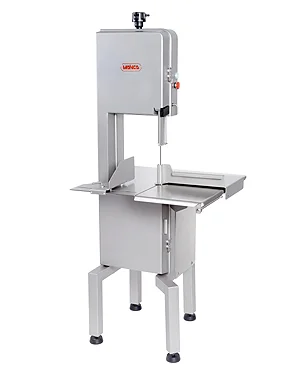
“Fresh” and “frozen” are starting descriptions.
A machine advertised for both conditions still needs a product-specific assessment. Bone distribution, shape, surface condition and dimensions can differ between lots. Keep the incoming material description separate from the finished portion specification.
Build a product envelope
| Product direction | Describe to the supplier | Check in the proposed trial |
|---|---|---|
| Fresh or chilled bone-in cuts | Species/cut, bone position, dimensional variation, firmness and measured incoming condition. | Holding and presentation, cut-face appearance, weight spread and treatment of irregular ends. |
| Frozen bone-in meat | Block or primal shape, packaging removal responsibility, bone direction and actual temperature range. | Machine opening, product restraint, blade suitability and recoverable portions. |
| Frozen fish | Species, whole/block/section form, skin/bone structure and incoming dimensions. | Product support, cut appearance, debris, ends and outfeed handling. |
| Boneless or mixed duties | Which products share the machine and what changes between them. | The supplier-approved blade and product-holder configuration for each duty. |
Read application statements within their scope
Kolbe K430 identifies fresh meat parts, frozen meat and frozen fish/block work as intended applications. Astech's current SRA Compact and PW-SAW descriptions make fresh-product use conditional on prior study. Starrett markets a distinct Meatkutter Frozen blade family. None of those facts establishes that every blade, holder and machine configuration suits every product condition.
Do not transfer a blade-family temperature statement into a universal machine limit, food-preservation rule or thawing recipe. Request confirmation for the exact machine, blade, product and operating conditions.
Useful sample descriptions
Too broad: “We cut beef and fish.”
More useful: “We need separate trials for bone-in beef sections and frozen fish blocks. The attached lot sheets show each size range and incoming condition. The required portions and outfeed arrangement are listed separately.”
This is an enquiry example, not a tested production specification.
Include variation before making the purchase decision
- List the smallest and largest pieces that must be presented to the machine.
- Keep the different incoming conditions identifiable in the trial record.
- Ask what preparation, product holders and blade item are included in the offered scope.
- Ask how mixed products affect changeover, cleaning and the onward packaging route.
Food-temperature control, sanitation validation and safe handling remain site-specific responsibilities. This page does not prescribe a process temperature or establish a food-safety release.
Continue the decision
Bone Saw Trial Record: Yield, Portion Weight & LossesBone saw types, working principles and dated market pricesSources and scope
Reviewed 2026-11-04. Manufacturer statements support the particular product or catalogue scope. Buyer questions, worksheets and arithmetic are editorial planning aids; they are not tested machine results or operating instructions. Manufacturer images remain attributed equipment references.
Source URLs, plain text
- https://kolbe-foodtec.com/en/product/bandsaws/k430-en/k430-2/
- https://www.astech.es/en/machines/sra-compact/
- https://www.astech.es/en/machines/pw-saw/
- https://www.starrett.com/products/meat-cutting-and-food-processing/band-saw-blades/meatkutter-frozen