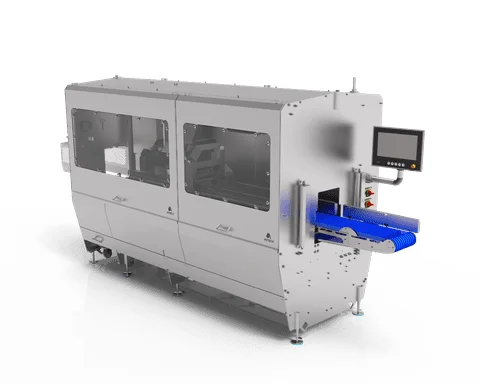
Record the material, the portions and the time separately.
This worksheet is for comparing supplier trials and documenting unresolved questions. It is not a commissioning checklist, an operating method or permission to release a machine or food product. Sampling plans and acceptance limits must be agreed for the project.
Download the blank bone-saw trial record (CSV)
The file contains field names and blank values. It includes no customer data or invented test results.
What to record for a bone-saw comparison
| Record area | Specific information | Keep separate |
|---|---|---|
| Identification | Machine/version, blade code and dimensions, holder/feed configuration and supplier-run recipe reference. | The settings actually reported by the supplier versus requested future configuration. |
| Input | Lot, species/cut, bone orientation, product dimensions, incoming condition and input mass. | Fresh, tempered and frozen lots; different product geometries. |
| Output | Portion count, mass and dimensions; cut-face/debris notes; ends, trim, rejects and recoverable pieces. | Saleable output, material for another use, retained material and unreconciled loss. |
| Time | Elapsed trial time and the agreed boundary: loading, cutting, collection, stops and changeover. | Steady cutting time versus elapsed time; cleaning observations versus productive runtime. |
| Unresolved items | Repeat runs needed, missing measurements and questions for the supplier. | Observed result, supplier claim and your decision. |
Use transparent measurements
- Accepted mass yield
- Mass classified as accepted under the agreed trial definition ÷ input mass × 100. State whether recoverable trim is included.
- Accepted output rate
- Accepted mass ÷ elapsed hours within the stated timing boundary. Do not label a steady-cutting-only rate as a full-shift result.
- Weight deviation
- Individual portion mass − target mass. Report the distribution and counts outside the agreed limits, not only the average.
- Positive overfill / giveaway record
- If useful for the project, sum only the positive deviations for the agreed portion set. Identify that set; underweight pieces do not silently cancel overweight pieces.
These are defined arithmetic measures, not promised performance. If input and output masses do not reconcile, document retained material and measurement gaps instead of assigning all missing mass to blade kerf.
One illustrative record, not a machine result
A hypothetical 10 kg input lot produces 8 kg classified as accepted, 1 kg retained for another use and 1 kg of recorded losses. Accepted mass yield is 80% under that definition. It becomes a different measure if recoverable material is included. These numbers demonstrate the calculation only; they do not represent a supplier trial or a typical yield.
Interpret the control system before interpreting the result
An automatic thickness recipe and a scanning-based target-weight recipe control different variables. Astech describes these as different equipment functions. Record which mode and product were actually demonstrated; do not infer fixed-weight capability from uniform-looking slices.
Use the site's general cutting-trial guide for the wider sampling discussion. Use this record for the bone-saw-specific product, blade and loss breakdown.
Continue the decision
Bone Saw Quotation Checklist & Cost per Kilogram CalculatorBone saw types, working principles and dated market pricesSources and scope
Reviewed 2026-11-04. Manufacturer statements support the particular product or catalogue scope. Buyer questions, worksheets and arithmetic are editorial planning aids; they are not tested machine results or operating instructions. Manufacturer images remain attributed equipment references.
Source URLs, plain text
- https://www.astech.es/en/machines/sra-compact/
- https://www.astech.es/en/machines/pw-saw/