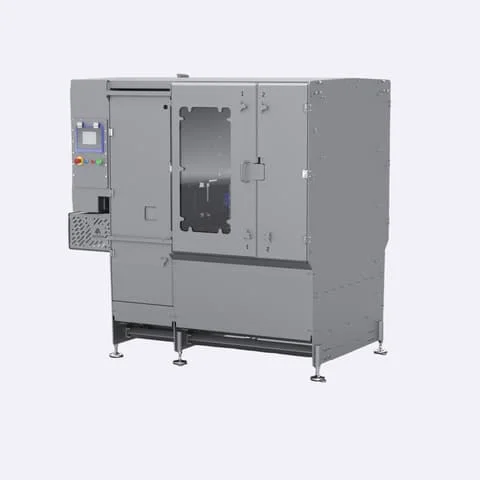
Choose the feeding and control concept.
A powered blade does not make a saw automatic. On a table bandsaw, the operator still positions and presents the product. A sliding carriage supports that movement. An enclosed automatic saw adds a controlled cutting cycle; a target-weight system adds another layer of measurement or estimation.
Compare four arrangements
| Arrangement | What the machine controls | What remains to compare |
|---|---|---|
| Manual fixed table | The blade motion; a stop can define distance. | Product presentation, loading, small end pieces, collection and cleaning. |
| Manual sliding/rolling table | Blade motion with a moving product support. | Carriage travel, product holding, loading effort and available workspace. |
| Automatic thickness cutting | Programmed feed/cut sequence for a defined thickness. | Permitted product shapes, grippers, recipe changes, loading and outfeed. |
| Automatic target-weight cutting | A system such as PW-SAW combines scanning with selected weight/thickness parameters. | Actual weight distribution, end-piece policy, giveaway and downstream checking. |
Read the examples correctly
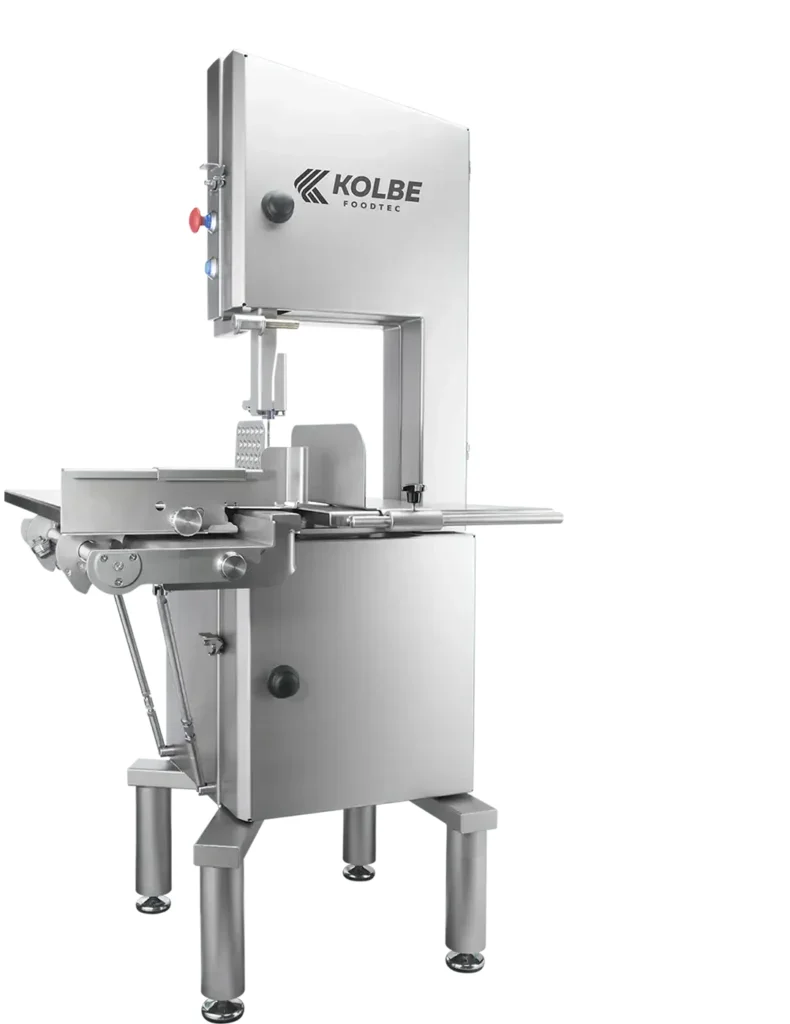
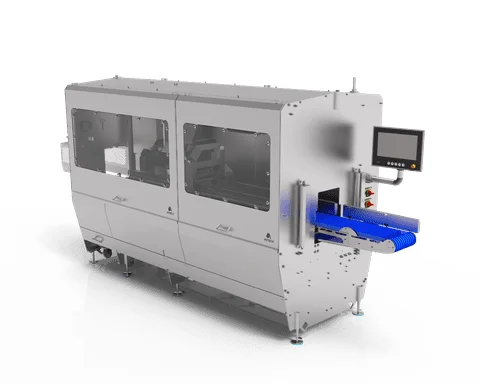
Kolbe documents manual workstation configurations and Astech documents enclosed programmed or scanning-based systems. These illustrate architecture, not an equipment ranking. Enclosure or automation is not a guarantee of zero risk, fewer operators or a particular output.
When to investigate each route
- Varied small batches: compare manual layouts against product handling and changeover needs.
- Repeated portions: investigate automatic loading, product holding and discharge as a complete arrangement.
- Weight-led packs: ask how weight is estimated or measured, how cut decisions are made and how finished portions are checked.
- Existing labour constraints: count all loading, collection, sorting and cleaning duties; do not equate one automatic cutting head with an unmanned line.
Bring the same scenario to each supplier
Use the same product envelope, mix of SKUs, planned hours, accepted-output definition and handover to packaging. Compare realistic time records, floor/service access and the quote boundary. A higher nominal cut count alone cannot settle the choice.
Continue the decision
Bone Saw Quotation Checklist & Cost per Kilogram CalculatorBone saw types, working principles and dated market pricesSources and scope
Reviewed 2026-11-04. Manufacturer statements support the particular product or catalogue scope. Buyer questions, worksheets and arithmetic are editorial planning aids; they are not tested machine results or operating instructions. Manufacturer images remain attributed equipment references.
Source URLs, plain text
- https://kolbe-foodtec.com/en/product/bandsaws/k330rs-en/k330rs-2/
- https://kolbe-foodtec.com/en/product/bandsaws/k430-en/k430-2/
- https://www.astech.es/en/machines/sra-compact/
- https://www.astech.es/en/machines/pw-saw/