Crop guide · Bok choy preprocessing
Start with the form you intend to sell
Whole bok choy, separated leaves and cut cooking ingredients need different equipment settings and transfers. This guide explains six duties: washing, trimming, cutting, sorting, dewatering and packaging. Bok choy is also sold as pak choi or pak choy; it should not be confused with a tightly heading napa-cabbage product.
Three product forms, three handling briefs
Intact whole plants
Receiving and selection → conservative root-end/outer-leaf trimming → washing under the agreed process → draining and suitable surface-water removal → final inspection and size matching → supported packing.
Keep the plant together. Preserve the required base and leaf attachment. A loose-leaf cutter or basket spinner is not automatically suitable for this route.
Separated leaves with stalks
Receiving → remove the base and unwanted material as specified → separate and inspect leaves → washing → dewatering selected for the actual leaf/stalk mixture → dosing and packing.
Define the retained stalk. The thick pale stalk and soft green blade must both remain acceptable after washing and water removal. Agree the position of inspection and any pre-rinse with the process team.
Cut cooking ingredients
Receiving → trimming and preparation → cut to the required form → wash and inspect at the specified points → drain/dewater → controlled dosing and packaging.
Define what goes into the pack. Mixed leaf-and-stalk pieces and separately collected fractions are different outputs. Cooking, blanching, freezing and their downstream packaging are additional process briefs.
Trimming: decide how much of the base must remain
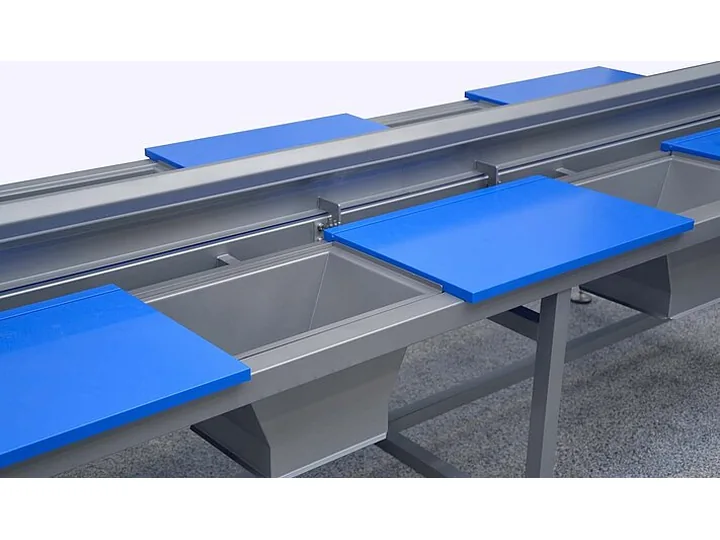
Give root-end trimming a clear workspace
A preparation table supports manual trimming and keeps removed material on a separate path. The actual cut depends on whether the customer wants an intact plant, separated leaves or prepared pieces. This workstation is not an automatic bok choy root-removal machine.
Set a written standard for root ends, damaged outer leaves, ties and any unwanted stem material. For intact packs, check that trimming retains the required plant structure. For separated leaves, specify how the base is removed and how the leaves are collected.
Compare the workstation: support for incoming crates, operator reach, knife handling, waste chutes and transfer into the next machine. The manual station shown explains that work layout; it does not promise a particular staffing level, trim yield or automatic removal result.
Cutting: specify both the leaf and the stalk result
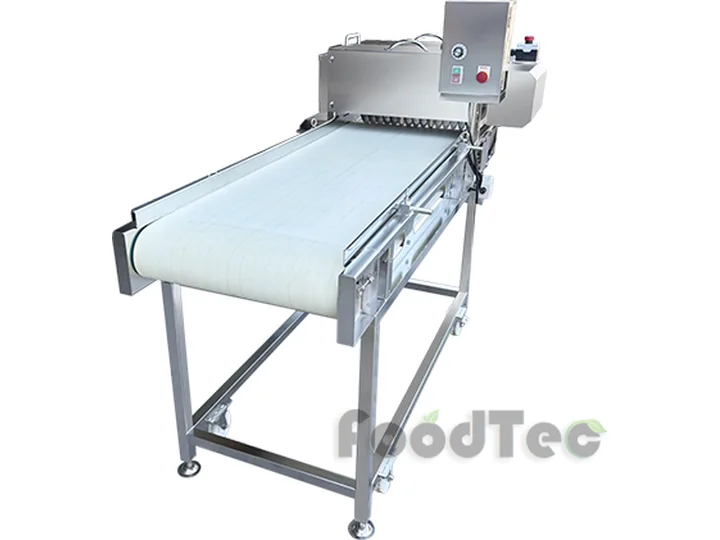
A cutter with a defined blade arrangement
FOODTEC explicitly lists bok choy among the FT-301B applications. The machine has a fixed cutting pitch for each supplied configuration and an adjustable stem-length guide. The guide adjustment should not be mistaken for infinitely adjustable blade spacing.
An intact retail plant normally bypasses the cutter. Prepared ingredients may need cross-cut pieces or separately collected leafy and stalk portions. Give the supplier samples and drawings of the desired result, including any long or fibrous material that must be retained or removed.
For FT-301B, distinguish the supplied fixed blade arrangement from the adjustable stem guide. Ask which cutting pitch is included, what a different size requires and how the offered setup divides the outgoing material. Avoid comparing it as though every vegetable cutter uses the same adjustment system.
Follow the sample after cutting: inspect crushed stalks, torn leaves, fines, piece variation and useful output. Check it again after washing, dewatering and pack handling. The film below helps explain feed orientation and the outgoing conveyor; it does not establish an acceptance result.
Washing: test the base and leaf-stalk junctions
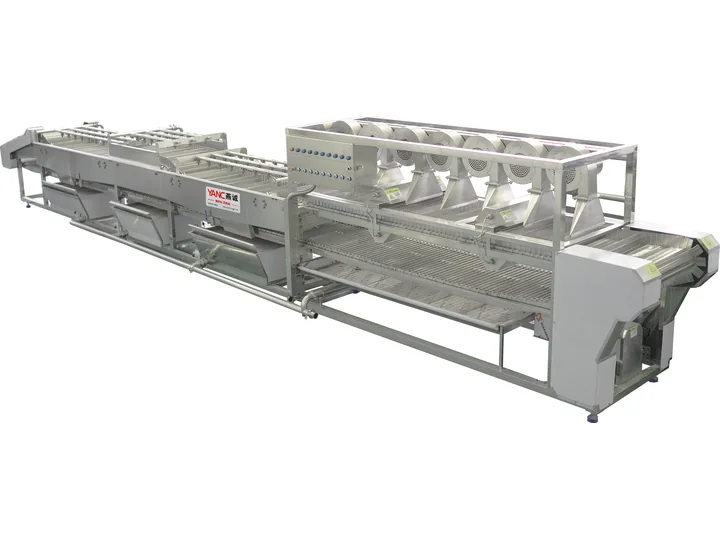
A whole-vegetable wash-and-drain reference
YANC lists bok choy in this whole-vegetable line application. Its connected layout combines washing, draining and air drying. This picture identifies an arrangement to discuss with the supplier; it does not establish the cleaning result inside your particular bok choy plants.
For whole plants, ask the supplier to demonstrate water access around and between the retained stalks. Inspect the difficult areas in actual samples after the trial. For separated leaves or cut pieces, compare agitation, product distribution, leaf damage and discharge under those different conditions.
Inspect the complete wash circuit: pre-cleaning where specified, soil/debris removal, screens, spray coverage, water management, drainability and cleaning access. Do not assume that adding more stages guarantees a particular hygiene outcome.
The YC-ZC9000 reference combines several washing and water-removal duties. Define each duty and its acceptance check in the quotation. No universal chemical concentration, water temperature, treatment time or microbial-reduction claim is specified here.
Sorting: keep quality selection separate from product splitting
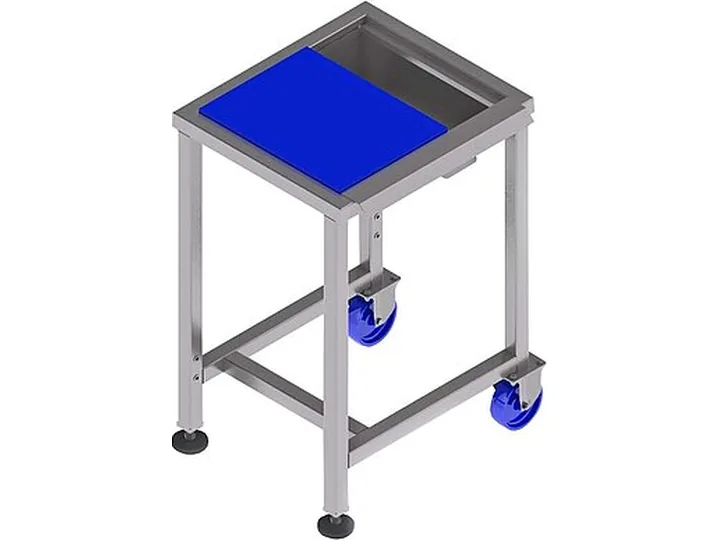
A manual station keeps the quality decision visible
A supported inspection position gives an operator room to examine the plant, turn it where needed and remove unacceptable material. This is the same configurable workstation family as the preparation reference. It is not an optical grader or an automatic size-sorting system.
For intact packs, define acceptable plant size, retained leaves, visible damage and presentation, then choose an inspection table or conveyor that lets operators examine those features. Record how accepted plants are grouped and where rejected material goes.
For prepared products, inspect the actual leaf-and-stalk stream at the agreed point. A cutter that separates stems and leaves has divided the product; it has not necessarily removed discoloured leaves, foreign material or other defects.
If camera or optical sorting is proposed: require a supplier-confirmed bok choy configuration and an agreed challenge trial. Whole plants, detached leaves and wet cut pieces need different presentation. Check both missed defects and good-product loss; no universal optical-detection capability is inferred from leafy-vegetable advertising.
Dewatering: compare intact plants with loose product
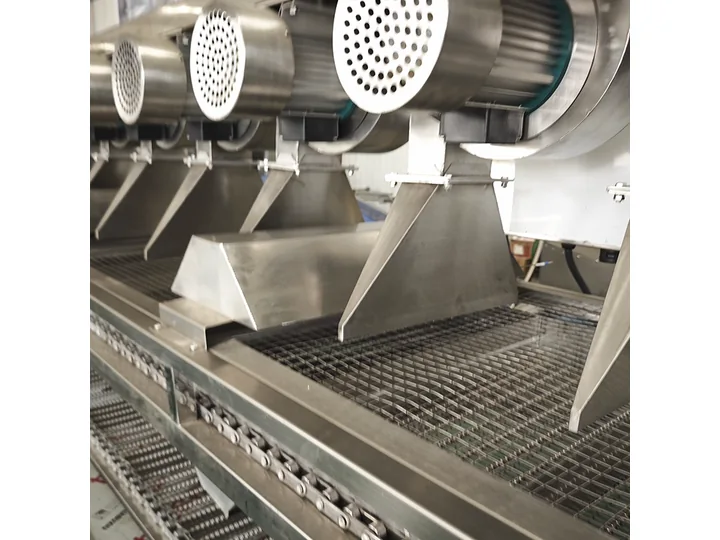
Inspect the air treatment above the transfer belt
The detail makes the air-treatment position relative to the product belt visible. Specify how intact plants are supported, drained and presented to the air stream, then inspect remaining free water and leaf condition. Do not equate this arrangement with a heated drying tunnel or sterilisation.
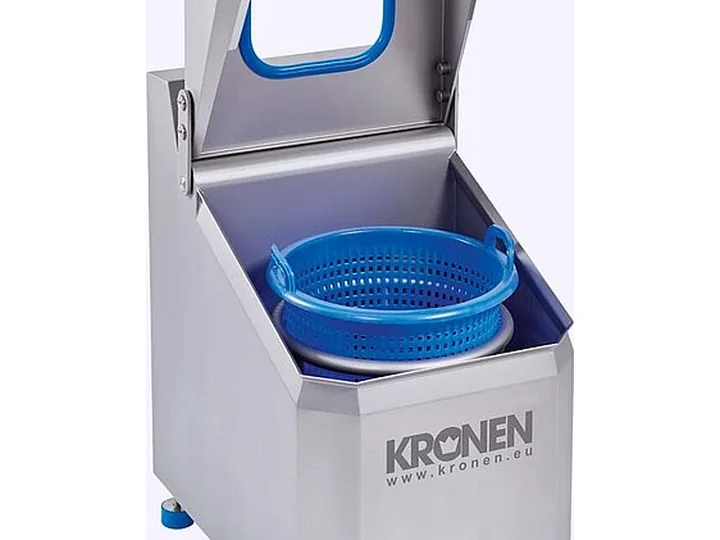
A basket spinner is a different product-handling brief
A removable-basket centrifuge is a reference for leaf and cut-vegetable water removal. This picture does not prove suitability for intact bok choy. Ask for a trial of the intended separated leaves or cut pieces, including loading, unloading, damage and basket cleaning.
Start with drain-down and the product's orientation. Water remaining among retained stalks presents a different handling question from water on detached leaves. Trial the complete transfer from the washer to the packer, including stops and accumulation.
| Product form | Arrangement to compare | Acceptance checks |
|---|---|---|
| Intact plants | Supported drainage and a supplier-confirmed air-treatment conveyor. | Water retained around the base, plant orientation, loose or bruised leaves and pack presentation. |
| Separated leaves and stalks | Drainage followed by a confirmed basket, drum or air system. | Different leaf/stalk behaviour, load distribution, remaining free water, breakage and handling effort. |
| Cut pieces | A configured draining or centrifugal route matched to piece size. | Fines escaping through openings, damage, clumping, carry-over water and cleanability. |
Agree a method to assess remaining free water and useful product after holding. Do not assume that a loose-leaf spinner can accept whole plants, or that one speed and cycle suits every cut. Surface-water removal is not cooking, sterilisation or proof that the product is ready to eat.
Packaging: leave room for leaves and reliable seals
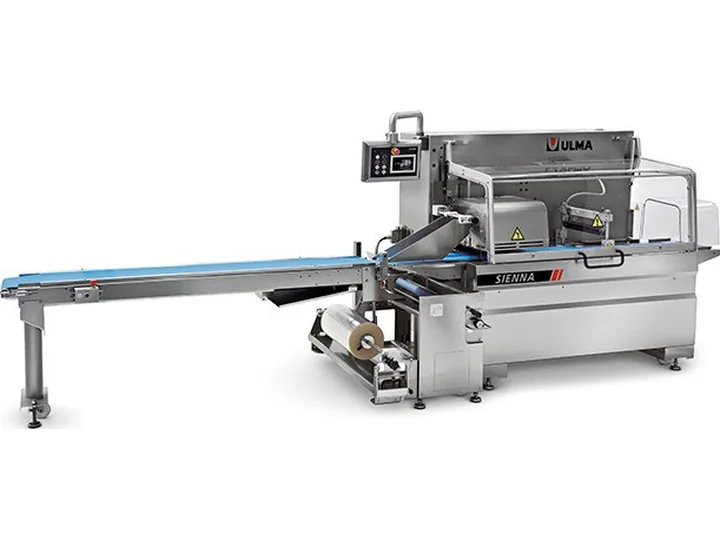
Support the product through a horizontal wrapper
ULMA links SIENNA to a whole-lettuce wrapping application. It illustrates a horizontal pack format to compare for intact bok choy, not a verified bok choy configuration. Confirm the actual plant dimensions, orientation, support and seal clearances with samples.
Intact plants: compare the agreed bag, sleeve, tray or flow-wrapped format. Check plant height and spread, support, orientation, leaf snagging, film clearance and transport protection. The SIENNA image is a whole-leaf packaging-family reference from ULMA's lettuce application; bok choy compatibility needs its own trial.
Separated or cut product: compare controlled weighing/dosing into the chosen bag, pouch or tray. Leaf and stalk pieces may feed differently. Inspect bridging, compression, water at the seal, product trapped across the jaw, net weight and coding.
If MAP is required, specify the actual gas equipment, film, pack geometry and distribution process. Do not assume a normal sleeve, every flow wrapper or a different supplier's standard packer provides those functions. No gas recipe or shelf-life promise is inferred from the machine photographs.
See the cutter's feed and transfer arrangement
This official manufacturer film addresses a concrete decision: how stemmed leafy vegetables are presented to a circular-blade cutter and transferred afterwards. It opens on YouTube and has English viewing notes, so the page remains useful without playback.
Watch aligned feeding and the cut-product transfer
FOODTEC's official FT-301B product page links this working film. It shows stemmed leafy vegetables being presented to the cutter and cut material moving away. Use it to understand orientation and product transfers, then specify a trial with your bok choy.
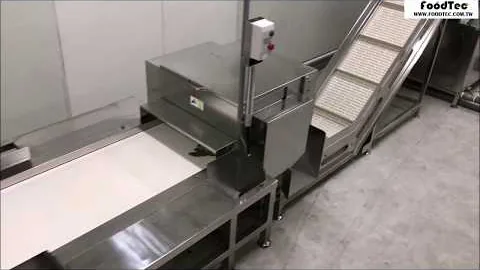 Watch on YouTube ↗ · 1:06
FOODTEC Machinery Corp. · Official manufacturer footage
- Around 0:19: inspect the orientation of the stems and leaves on the infeed. Ask what presentation and preparation your raw material requires.
- Around 0:32: follow the cut leafy material on the inclined conveyor. Look at piece variation, transfer height and possible accumulation.
- Around 0:44: compare the cutting enclosure and discharge layout. Ask the supplier to identify the leaf and stem paths on the offered configuration.
This older manufacturer demonstration is not a measured bok choy yield or capacity test, and it is not a safe operating procedure. Product separation after cutting does not demonstrate defect detection. The original film has no dependable technical captions; these English observations supply viewing context.
Build the trial around your bok choy
- Define incoming material: variety/form, whole or loose, plant dimensions, roots, ties, temperature history and realistic incoming variation.
- Provide three clear standards: the trim line, retained whole/leaf/cut form and a finished-pack sample.
- Follow saleable output: include trim waste, fines, rejected quality, leaf damage, rework and rejected packs.
- Include the connections: line heights, supported drops, draining, baskets or buffers, downstream interruptions and restart.
- Include cleaning and changeovers: guards and safe access, water circuits, screens, drains, tools, utilities, commissioning and supplier acceptance checks.
Questions before choosing the equipment
Must every bok choy line include a cutter?
No. Intact fresh plants normally bypass cutting. Separated leaves or prepared cooking ingredients need their own trim and cut specification.
Does leaf-stem separation count as quality sorting?
No. Product splitting and quality rejection answer different questions. Specify the accepted product and defects separately, then inspect the actual outgoing streams.
Can a salad spinner dry intact bok choy?
A loose-leaf reference alone does not establish that. Whole plants need a supplier-confirmed handling arrangement and a trial that checks retained water and damage.
Does washing or MAP establish a ready-to-eat claim?
No such claim follows from a machine purchase. The complete process, hygiene controls, validation, packaging and distribution requirements must be assessed together.
Sources, image credits and review scope · 2 November 2026
Equipment images come from the named manufacturers. The two workstation views show one configurable family serving manual preparation and selection; the basket image is a detail, and the wrapper is a studio reference. No image or film is presented as a Food Machinery IQ installation or a verified bok choy acceptance test. Supplier inclusion is permanently free; supplier source addresses are plain text.
- FOODTEC: FT-301B circular blade cutter and official demonstrationhttps://www.foodtec.com.tw/product/cutting-machines/circular-blade-cutting-machine-ft-301b
- YANC: YC-ZC9000 whole-vegetable washing and air-drying linehttps://www.yanc-foodtec.com/whole-vegetable-washing-and-air-drying-production-line_yc-zc9000
- KRONEN: configurable preparation workstationhttps://www.kronen.eu/en/solutions/trimming-table-for-4-people
- KRONEN: KS-100 PLUS vegetable and lettuce spin-dryerhttps://www.kronen.eu/en/solutions/vegetable-and-lettuce-spin-dryer-ks-100-plus
- ULMA: whole-lettuce flow-wrapping applicationhttps://www.ulmapackaging.com/en/packaging-solutions/produce/fresh-vegetables-without-tray/lettuce-packaging-in-flow-pack-wrapper-hffs
- ULMA: SIENNA horizontal flow wrapperhttps://www.ulmapackaging.com/en/packaging-machines/flow-pack-hffs/sienna
- UC Davis: bok choy product identity and quality criteriahttps://postharvest.ucdavis.edu/produce-facts-sheets/bok-choy
Model/application scope and the official film were checked. Promotional output, hygiene, UV-treatment and shelf-life statements are not adopted as independently verified results. Current signed specifications and a product trial remain the procurement basis.