Crop guide · Arugula preprocessing
Keep the required leaf intact, clean and easy to pack
Arugula is also known as salad rocket or roquette. This guide follows six equipment duties: washing, trimming, cutting, sorting, dewatering and packaging. Begin with actual incoming leaves and the retained product your customer expects.
A manufacturer-documented rocket washing and drying line provides an application reference for GEWA 4000 PLUS and K850 equipment. Preparation, cutting, inspection, basket spinning and bagging images explain the other duties with their limits stated. No equipment picture is presented as a Food Machinery IQ installation.
Three product briefs to separate
Intact tender leaves
Receive and inspect → remove unwanted material → configured washing → drain and remove free water → final selection → dose and pack.
Keep the required leaf intact and bypass the cutter. Agree accepted stalks and leaf condition, then trial the actual load and transfers. If the leaves enter a salad blend, specify component dosing and the mixing position separately.
Prepared mature leaves
Receive → unpack bunches where supplied → inspect and trim to the retained-leaf standard → wash → dewater → inspect → portion and pack or transfer.
Define which stalks or coarse material are unwanted. Manual preparation and product presentation may differ from a loose tender-leaf stream. Show a retained sample and a discard sample.
Cut cooking ingredients
Receive → specified trimming → controlled feeding → cut → configured washing and selection → dewater → weigh and pack or transfer to the next process.
Specify leaf and retained stalk dimensions together. Chopping a stalk short does not remove it. Further cooking, freezing or other processing needs its own specification.
Agree the sequence of pre-cleaning, inspection, cutting and final washing with the supplier for the actual incoming material. These routes are specification aids, not universal process settings.
Trimming: define the retained leaf before removing stalks
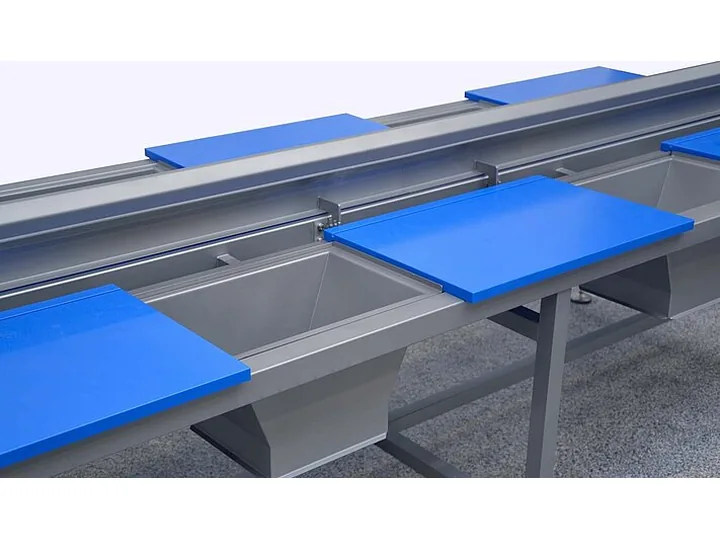
Remove unwanted material without losing useful leaf
Specify accepted stalk length, damaged material and the retained leaf before arranging manual trimming. Keep good leaves and rejects on separate paths. This workstation illustrates preparation; it is not an automatic arugula destemmer.
At receiving, define accepted leaf size, condition and stalk length. Where bunches or packaging arrive with the product, remove ties and unwanted material before loose-leaf processing. Inspect mature material against the customer's retained-product standard.
For a preparation station, compare support, operator reach, collection and separate waste removal. Assess torn leaves, stalk fragments and useful product in the discard stream. No automatic arugula leaf-stripper has been verified for this guide; require a crop-specific demonstration if one is proposed.
Cutting: preserve whole leaves unless a cut is required
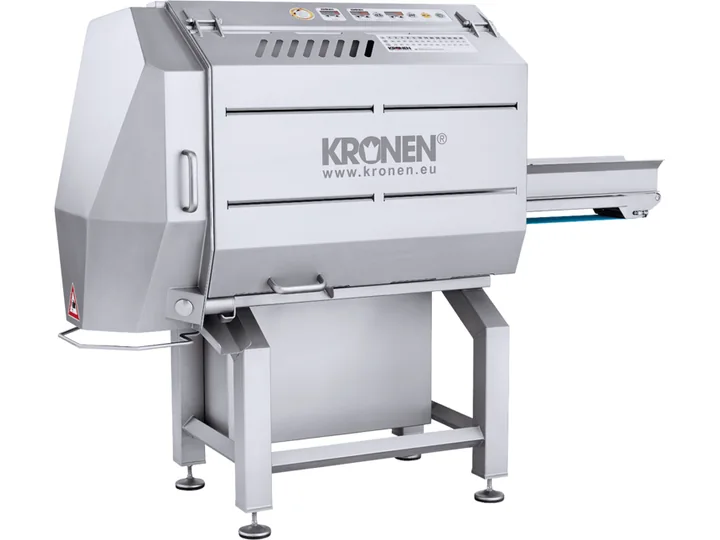
Cut only when the finished ingredient needs it
The GS 10-2 is a lettuce and prepared-produce cutting-family reference. For cut arugula ingredients, ask for the actual feed and tooling trial. The reference does not establish a particular arugula cut, yield or output rate; an intact-leaf product normally bypasses it.
An intact-leaf pack needs a supported cutter bypass. For a prepared ingredient, specify the target pieces, retained stalk content and acceptable long fragments, torn edges and fines. Ask how the feed system spreads the actual leaf form rather than allowing an uncontrolled bundle to enter.
Inspect useful output after cutting, washing, dewatering and a realistic hold. A cutter-discharge sample alone does not describe the packed product. Cutting is a size-change duty; it does not replace trimming or quality selection.
Washing: match light leaves to water movement and transfers
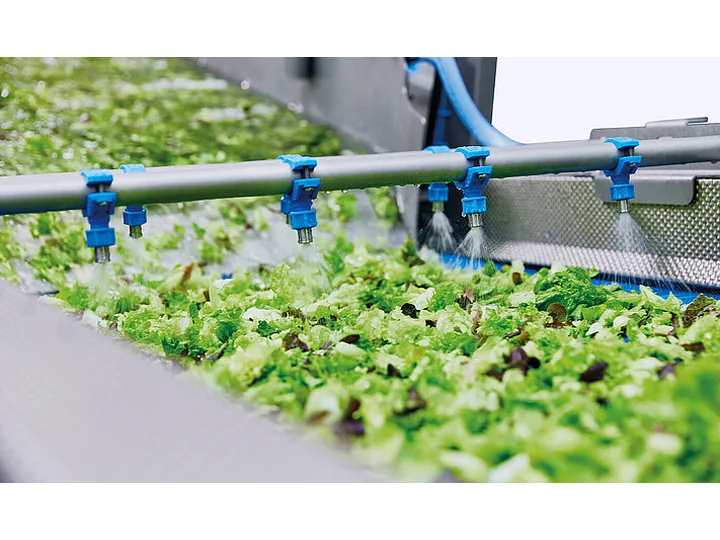
Follow the leaves onto the washer outfeed
KRONEN's 2023 rocket-line report specifies two GEWA 4000 PLUS washing stages. This current family photo shows the outfeed and rinse arrangement with other lettuce. Check your actual leaf spread, drainage and next transfer rather than treating the image as a rocket acceptance result.
The 2023 manufacturer report describes a line ordered for baby leaf and rocket, using two GEWA 4000 PLUS washing machines and a K850 drying system. Use that as documented application evidence, while specifying your current product, machine options and acceptance trial separately.
Compare product distribution in the tank, incoming soil and debris removal, fine-material separation, screens and the outfeed. Inspect leaf folds and retained stalk areas after the trial. Track useful leaves lost into debris removal and pieces caught at transfers.
Specify water filling, replacement or recirculation management, draining, rinse arrangements and cleaning access. Include stops and restart. A line photograph or manufacturer application listing does not establish a universal chemical dose, contact time, microbial reduction or ready-to-eat status.
Sorting: make the rejection decision explicit
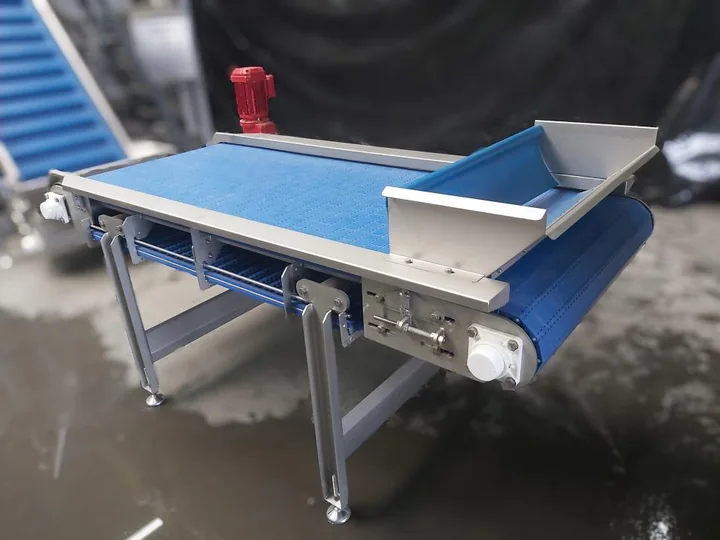
Expose small leaves and the unwanted material
An inspection surface gives operators access to the product and a separate reject path. Confirm how the proposed feed spreads your arugula leaves. This general conveyor reference is not a verified optical sorter or an arugula detection guarantee.
Write down the unwanted material and accepted leaf condition before selecting equipment. Compare manual access, lighting, wet reflections, overlap, layer depth and reject collection. Check whether operators can expose the feature that matters without damaging useful leaves.
A proposed optical sorter needs a supplier-confirmed arugula configuration and a challenge trial covering both missed defects and good-product loss. The inspection belt shown here supplies presentation and transport, not automatic detection. Mechanical size separation, foreign-material removal and quality selection are different duties.
Dewatering: compare a basket workflow with an automated line
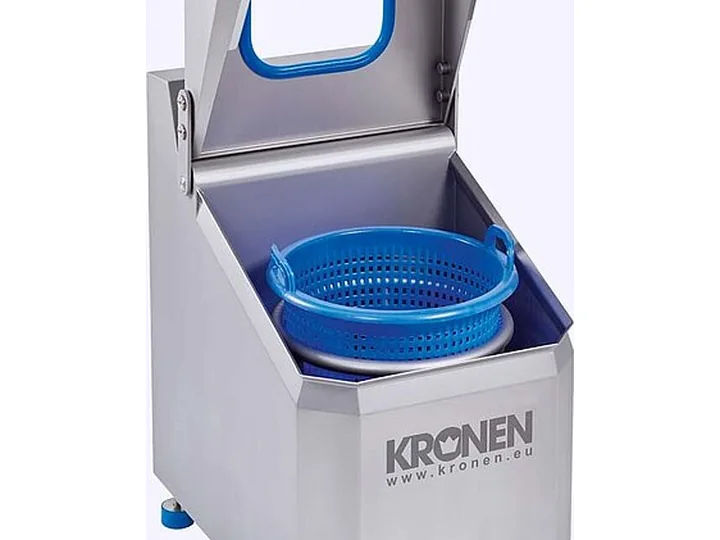
Make batch loading and unloading visible
A basket-based lettuce/vegetable system provides a batch water-removal reference. Trial the actual arugula load, distribution, cycle and release. Inspect free water, leaf damage, clumps and small material lost through openings; no universal cycle is specified.
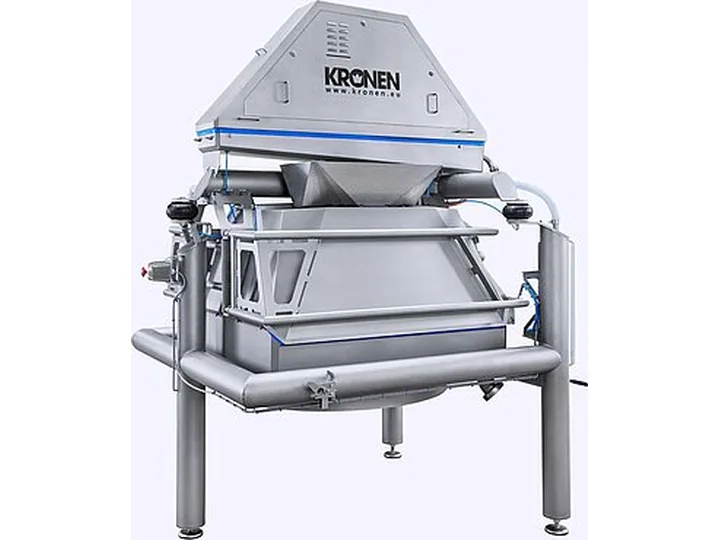
Understand the centrifuge within an automated line
The current K850 page includes rucola among its applications, and the 2023 rocket-line report identifies this drying system. The image shows the centrifuge unit; the complete line also needs its specified infeed buffer, transfer and discharge conveyors.
Basket-based operation: compare actual loading, distribution, cycle, drainage and unloading effort. Inspect free water, leaf tearing, clumps and fines after a representative hold. The removable basket picture explains the workflow, not a validated arugula setting.
Automated line operation: the K850 connects a buffer conveyor to a centrifuge and downstream discharge. KRONEN explains that the line operates continuously through the buffer while the centrifuge itself dries in batches. Specify these connections and controls; a continuous line does not mean uninterrupted product passage through the spinning drum.
| Compare | Basket workflow | Automated line |
|---|---|---|
| Feed control | Define manual load and distribution. | Specify buffer, batch loading and washer coordination. |
| Small-leaf retention | Confirm basket openings and unloading. | Confirm supplied screen and transfer design with the product. |
| Acceptance | Check free water, damage, clumps and handling. | Apply the same finished-leaf standard after realistic line interruptions. |
Agree the actual residual free-water assessment and the required leaf condition with the supplier. No published maximum line rating is transferred to your arugula product. Surface-water removal is separate from thermal drying, cooking or sterilisation.
Packaging: keep the leaf feed and sealing area under control
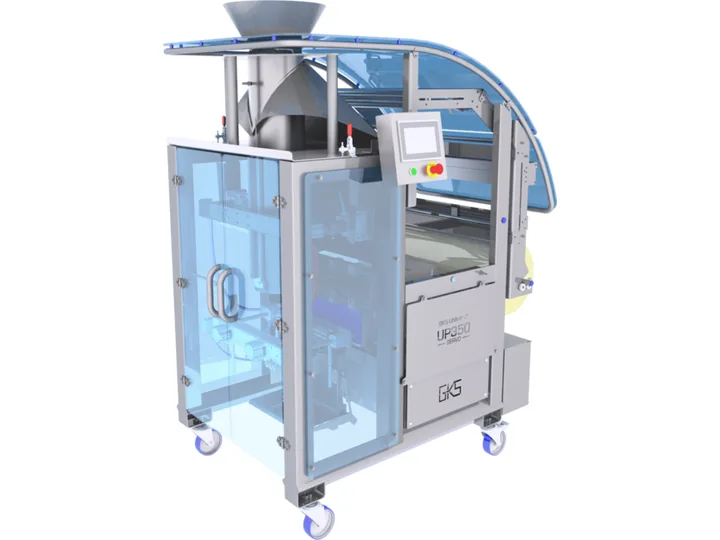
Control the leaf dose before judging the bag
Compare the connected weigher/doser, leaf drop and bag geometry as well as the packer. FLEX L is a general produce bagging-family reference. Confirm actual arugula feeding, seals and any gas-handling option in the offered configuration.
Specify the actual loose-leaf or cut product, weigher/doser, drop height, pack weight and bag or tray. Trial bridging, leaf compression, settling and the release into the packer, including stops and restart.
Inspect weight variation, leaves across the sealing area, residual water, seal leaks, coding and rejected packs. For blends, define recipe control and how good components remain consistently represented in the finished pack.
If MAP is proposed, obtain the specified gas-handling system, film, seals and distribution brief. A general bagger reference does not establish every gas-flushing option, gas recipe or shelf life for arugula.
See the line connections before specifying automation
The film makes the water handling, pre-dewatering transfer and final discharge tangible. It complements the written distinction between a continuously supplied line and a centrifuge that works in batches.
Watch the washing-to-dewatering connection
This official KRONEN film shows the GEWA 4000 PLUS and K850 line family described in the manufacturer's baby-leaf and rocket project report. Use it to understand water handling, the transfer toward drying and the downstream discharge. The visible product is mixed lettuce rather than a confirmed isolated arugula run.
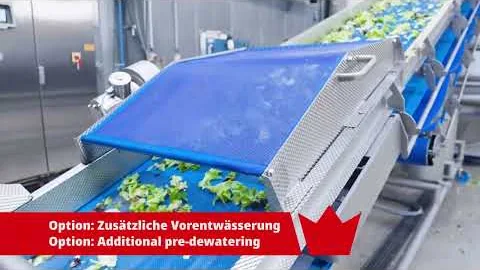 Watch on YouTube ↗ · 2:22
KRONEN Food processing · Official manufacturer footage
- Around 0:33: the water-management view shows water entering the tank beside the outfeed belt. Use it to locate filling and draining duties; this empty-water view does not measure leaf cleaning.
- Around 1:28: mixed lettuce passes through the illustrated optional pre-dewatering section. Ask which options your quotation includes and how the transfer handles light arugula leaves.
- Around 1:58: mixed leaves emerge from below the centrifuge onto a belt. Look at the discharge and product spread before specifying downstream inspection, buffering and dosing.
The film was observed as approximately two years old; the linked project report is dated 2023. The current offered configuration still needs confirmation. Its title's line-capacity figure is not an arugula output promise. YouTube displayed captions as unavailable; these original English notes provide a text alternative. No measured arugula cleaning, damage, residual-water or shelf-life result is inferred from the footage.
Prepare an arugula equipment trial brief
- Bring representative leaves: actual variety or trade name, maturity, accepted stalks, incoming condition and variation.
- Show the retained product: intact or cut, single crop or blend, permitted defects and finished pack.
- Record useful output: trim loss, damaged leaves, fines, unwanted material, rework and rejected packs.
- Test interfaces and interruptions: supported drops, water drainage, basket handling or automated buffers, downstream stops and restart.
- Agree acceptance and cleaning: include water circuits, drains, safe access, tool changes, utilities and supplier training.
Questions before choosing arugula equipment
Does every arugula line need a cutter?
No. An intact-leaf product normally bypasses cutting. Specify a cut only when the finished ingredient requires it.
Is a continuously supplied drying line the same as continuous spinning feed?
No. The K850 description explains that its buffer maintains line flow while the centrifuge dries in batches. Match loading and discharge to the washer and packer.
Does the video show a measured rocket trial?
The manufacturer's project report includes rocket as an intended crop. The visible footage shows mixed lettuce; it is not a measured arugula acceptance run.
Can a line-capacity headline be used as an arugula guarantee?
No. Product form, loading, water removal, transfers and packaging determine useful line output. Agree the actual crop-specific result in a trial.
Sources, image credits and review scope · 2 November 2026
Images are attributed manufacturer equipment, preparation and process references. The wash photograph and film show other lettuce or mixed leafy material; the inspection conveyor is a general workshop reference. The K850 image shows the centrifuge unit, not the complete conveyor system. None is presented as a Food Machinery IQ installation or an independently measured arugula trial. Supplier inclusion is permanently free; source addresses are plain text.
- UMass Amherst: Arugula, also known as salad rocket or roquettehttps://www.umass.edu/agriculture-food-environment/nutrition/publications-resources/produce-spotlight/arugula
- KRONEN: 2023 washing and drying line specified for baby leaf and rockethttps://www.kronen.eu/en/news/video-a-processing-line-for-up-to-4000-kg-h-of-salad-leaves-and-vegetables
- KRONEN: GEWA 4000 PLUS washing machinehttps://www.kronen.eu/en/solutions/washing-machine-gewa-4000-plus-with-vibration-or-belt-outfeed
- KRONEN: K850 drying system, including rucola applicationhttps://www.kronen.eu/en/solutions/drying-system-k850
- KRONEN: configurable preparation workstationhttps://www.kronen.eu/en/solutions/trimming-table-for-4-people
- KRONEN: GS 10-2 belt cutting machinehttps://www.kronen.eu/en/solutions/belt-cutting-machine-gs-10-2
- Herbort: Inspection Belt 85https://www.herbort-gmbh.de/en/products/machines/inspection-belt-85
- KRONEN: KS-100 PLUS vegetable and lettuce spin-dryerhttps://www.kronen.eu/en/solutions/vegetable-and-lettuce-spin-dryer-ks-100-plus
- KRONEN: FLEX L packaging machinehttps://www.kronen.eu/en/solutions/packaging-machine-flex-l
The 2023 project report supplies rocket application evidence. Current K850 information includes rucola and explains the batch centrifuge with continuous-line buffering. Other machine-family references require actual crop configuration and trials. No numerical capacity, microbial reduction, certification, energy saving or shelf-life promise is independently established here.