Crop guide · Mustard greens preprocessing
Follow the leaf from receiving to the finished pack
This guide covers leaf mustard greens: intact young leaves, trimmed mature leaves and prepared cut ingredients. It explains washing, trimming and destemming, cutting, sorting, dewatering and packaging with attributed manufacturer equipment images and an official YouTube demonstration.
Define the actual incoming crop and retained stalk before selecting a line. Leaf mustard is a different procurement brief from swollen-stem mustard for preserved products, mustard seed or mustard condiment. Those products are outside this leaf-processing route.
Three outputs, three different handling briefs
Intact young leaves
Receive and select → remove unwanted material → configured washing → drain and remove free water → inspect → dose and pack.
Keep the required leaf intact and normally bypass cutting. Agree accepted small stalks and the actual leaf condition. A tender-leaf pack needs its own loading and water-removal trial.
Trimmed mature leaves
Receive → unpack bunches where supplied → inspect and trim → remove coarse stalk to the retained-product standard → wash → dewater → inspect and pack.
Draw the retained stalk and midrib on a sample leaf. A complete leaf with some stalk retained differs from leaf sections with coarse rib material removed. Whole bunches require a separate presentation and packing brief.
Cut cooking ingredients
Receive → specified trimming → prepare and spread feed → cut → configured washing and selection → remove free water → weigh and pack or transfer to the next process.
State whether stalk pieces are wanted in the mix. A fresh cut product differs from raw material destined for blanching, freezing, cooking or fermentation. Specify those additional operations separately.
The sequence is a trial brief, not a universal process prescription. Agree the positions of pre-washing, cutting, inspection and final washing for the incoming material and finished-product requirement.
Washing: check folds, stalk junctions and the outfeed
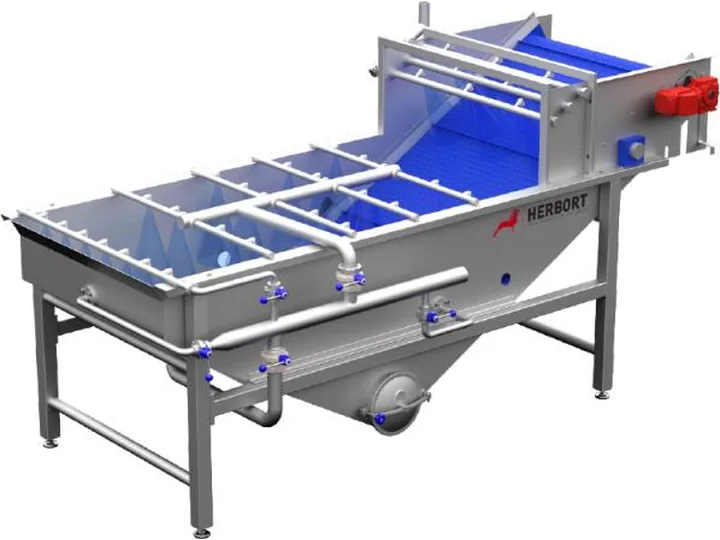
Match the wash action to the actual leaf and stalk
Herbort explicitly includes mustard greens in this washer's application description and identifies a circulating pump and spray nozzles. Use the image to discuss the product space and transfers. It is an equipment view, not a measured mustard-greens cleaning trial.
Show the supplier the actual whole or cut leaves and representative incoming soil and debris. Compare how the proposed water movement distributes them, opens overlapping material and transfers it to the outfeed. Inspect folds and the junction between retained stalk and leaf after the trial.
Specify incoming pre-cleaning where needed, debris separation, screens, water replacement or recirculation management, drainage and access for cleaning. Track useful leaves lost with debris and small cut pieces passing through openings. The washer and the next conveyor or dewatering system need compatible transfers.
Agree an assessed cleaning outcome. No universal chemical dose, temperature, contact time or microbial-reduction result is established here. Washing equipment alone does not establish ready-to-eat status, and a general manufacturer food-safety statement is not an independently verified guarantee.
Trimming and destemming: remove unwanted stalk before chopping it
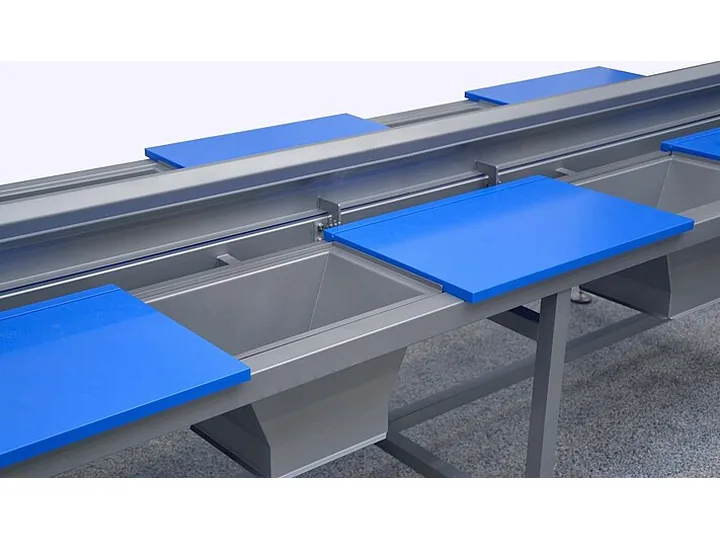
Decide which stalk stays with the leaf
Use a supported work surface to remove ties, damaged material and the specified coarse stalk. Show the operator a retained-leaf sample and a discard sample. This configurable workstation reference supports manual preparation; it is not an automatic mustard-leaf destemmer.
Trimming covers the agreed ends, damaged leaves and unwanted material. Destemming removes specified coarse stalk or midrib material from the retained leaf. Cutting that stalk into shorter pieces leaves it in the product.
At a manual station, compare support, reach, tool handling, good-leaf collection and the separate discard chute. Check leaf tearing, remaining rib fragments, useful leaf in the waste stream and actual work required across different leaf sizes.
If an automatic rib-removal or leaf-stripping machine is proposed, ask for a demonstration with your cultivar and retained-leaf standard. No automatic mustard-leaf destemmer has been verified for this page. A cabbage corer, grape destemmer or a machine for swollen mustard stems does not establish the requested leaf duty.
Cutting: specify the leaf and stalk together
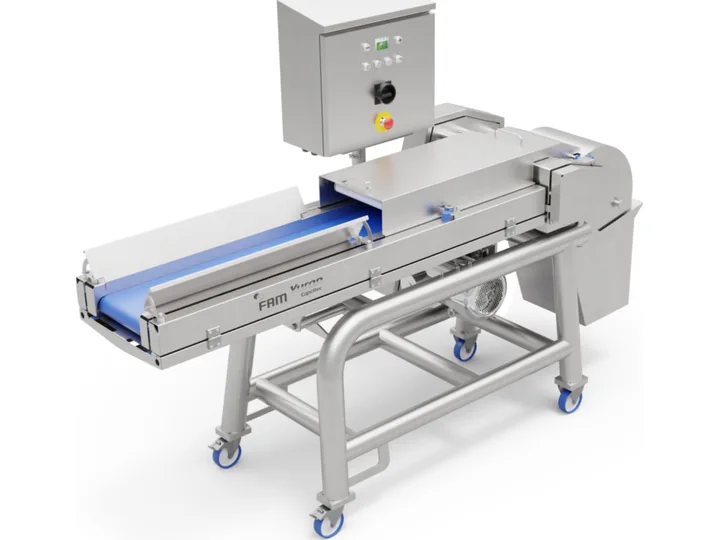
Specify prepared leaves and their feed presentation
The manufacturer's product sheet explicitly lists raw or blanched mustard leaves. That application statement supports a cutting reference, not a universal setting. Define whether the machine receives raw trimmed leaves, mixed leaf and stalk pieces, or material after a separate blanching process.
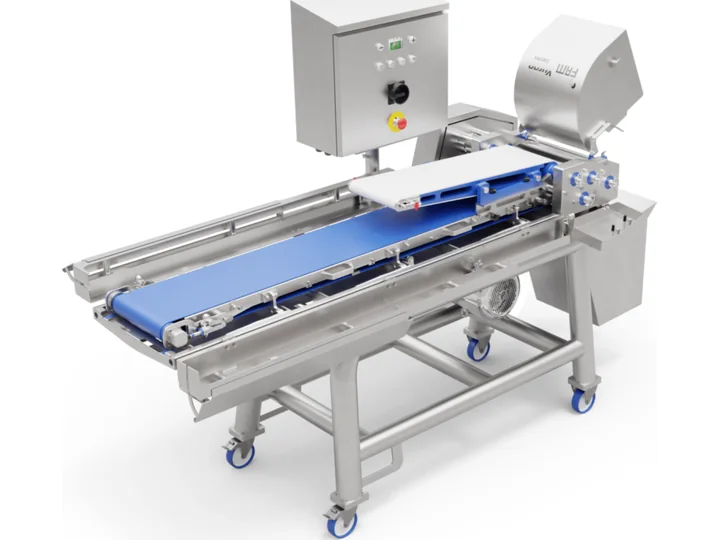
Understand the cutting unit before choosing a cut
The open view helps explain how feeding and cutting assemblies relate. Ask the supplier to identify the exact tooling and feed-roll or top-belt arrangement in the quotation. Guards, isolation, blade handling and cleaning access need the current manual and training; an open view is not permission to run exposed equipment.
FAM STUMABO's Yuran Capcitec product sheet explicitly names raw or blanched mustard leaves. Keep those feed states separate: blanching changes the material, and evidence for one state does not establish the settings for the other.
Agree the required strips or pieces, retained stalk content and acceptable long pieces, torn edges and fines. Trial consistent leaf spread and bed depth rather than feeding an uncontrolled bundle. A dicing-family name does not mean thin leaves will form regular solid cubes.
Inspect useful output after washing, water removal and a realistic hold, as well as directly below the cutter. Compare cuts across leaf maturity, stalk thickness and incoming variation. Bypass the cutter when the finished product requires an intact leaf.
Sorting: expose the defect before choosing a sensor
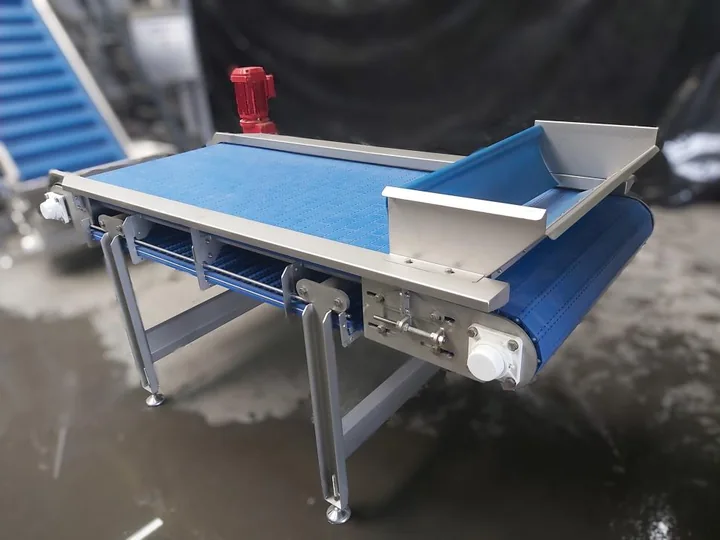
Spread the leaves so people can inspect them
An accessible conveyor provides a place for manual quality selection and separate removal of rejects. The manufacturer describes controlled transport and product spreading. Confirm the actual wet-leaf presentation and operator reach; this belt is not an optical detector or an automatic defect-removal guarantee.
Write down acceptable leaf condition, colour and retained stalk, plus the unwanted material to remove. Place manual selection where operators can see and turn the relevant product: at receiving, after trimming or on a suitably presented washed/cut stream.
Compare lighting, wet reflections, overlap, bed depth, reach and separate reject collection. For a camera sorter, request a supplier-confirmed leaf-mustard configuration and a challenge trial that measures both missed defects and good-product loss.
An inspection conveyor provides presentation and transport; it does not independently identify foreign material. Size separation, manual quality selection and optical rejection are different duties and should be named separately in the offer.
Dewatering: remove free water while keeping the required leaf
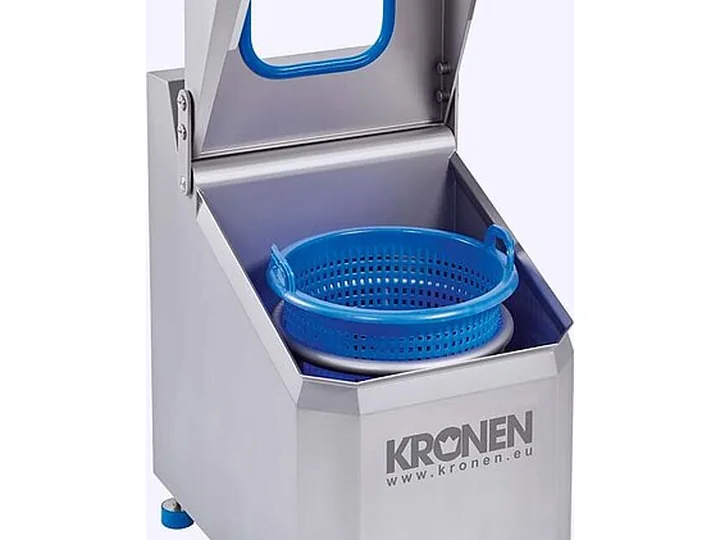
See the basket that receives the washed product
The basket view makes loading, distribution and unloading tangible. The current family page covers vegetables and lettuce; this guide does not claim a verified mustard-greens installation. Request a sample trial for your leaf size, retained stalk, loading pattern and required free-water outcome.
Start with drain-down and controlled transfer from the washer. For a basket centrifuge, compare the actual load distribution, cycle and unloading method with the supplier. Inspect for remaining free water, leaf damage and clumping after a representative hold.
| Product | Handling brief | Inspect after the trial |
|---|---|---|
| Intact young leaves | Controlled loading and a confirmed gentle route. | Leaf integrity, uneven loading, free water and release into the packer. |
| Trimmed mature leaves | Match the retained stalk and leaf size to the system. | Folding, water around ribs, tearing and unloading effort. |
| Cut ingredients | Confirm openings, fines retention and downstream dosing. | Small-piece loss, clumps, stalk/leaf distribution and standing water. |
A continuous centrifuge or air-removal proposal needs its own product trial and line balance. A screw press for another processing route is not automatically a substitute for removing surface water from a fresh leaf pack. Dewatering here is separate from thermal drying, cooking and sterilisation.
Packaging: inspect the feed path and the seal
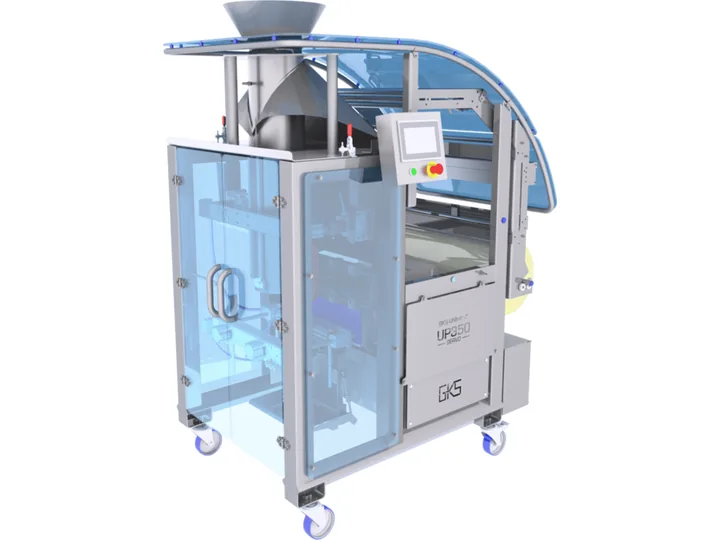
Match the doser and bag to the prepared greens
For loose leaves or cut greens, specify the connected weigher/doser, product drop and bag geometry as well as the bagger. This is a configurable packaging-family reference. The supplier must confirm mustard-greens feeding and sealing behaviour; the photograph does not prove a particular MAP configuration.
Loose leaves and cut greens: compare weigher/doser feeding, bridging, drop height, compression and the chosen bag or tray. Include stops and restart so backed-up wet leaves are part of the trial.
Large leaves or retained bunches: specify support and orientation separately. Compare the required sleeve, bag, tray or wrapping route; a loose-product vertical bagger is not proof of compatibility with every bunch.
Check net-weight variation, leaves across the sealing area, residual water, seal leaks, coding and rejected packs. For modified-atmosphere packaging, obtain the specified gas-handling system, film, seal validation and distribution brief. No gas mix or shelf-life promise is inferred from a machine image.
Watch the cutter layout, then ask for a product trial
The official model film makes the belt, upper feed component and cutting assemblies visible. It complements the real equipment references without pretending to be a complete mustard-greens production-line demonstration.
See how the feed belt and cutting assemblies fit together
FAM STUMABO's official Yuran Capcitec model demonstration uses equipment animation to explain its layout. Watch it beside the machine and open-tool views above to understand the feeding questions for a mustard-leaf cutting trial.
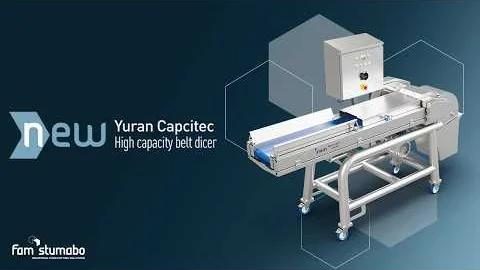 Watch on YouTube ↗ · 2:17
FAM STUMABO · Official manufacturer equipment animation
- Around 0:37: look at the profiled blue feed belt and the component above it. Ask how the selected feed arrangement will support and present your actual trimmed leaves.
- Around 0:57: the infeed view helps locate the working belt area. Compare upstream spreading and the transfer into the machine.
- Around 1:24: the open assembly view shows the cutting components and adjacent feed section. Use it to ask which tools produce the specified strips or pieces.
This is a model-layout demonstration, not footage of a mustard-greens acceptance run. It does not establish stalk removal, cut quality, yield or throughput for your product. YouTube displayed no captions; these original English observations provide a text alternative. Manufacturer promotional statements in the film are not adopted as independently measured results.
Prepare a mustard-greens equipment trial brief
- Identify the actual leaf product: cultivar, maturity, leaf size, stalk thickness, bunches or loose feed and incoming variation.
- Show the finished sample: retained stalk/midrib, intact or cut form, acceptable defects and pack presentation.
- Record useful output: trim waste, leaf loss, fines, damage, rejected quality, rework and rejected packs.
- Test the connections: supported drops, transfer heights, drain-down, baskets, buffers, interruptions and restart.
- Agree acceptance and cleaning: assess every stage with the supplier, including water circuits, drains, safe tool changes, utilities and training.
Questions before selecting mustard-greens equipment
Does this page cover mustard seed or swollen mustard stems?
No. It covers leaf mustard greens. Seed milling, condiment manufacture and swollen-stem preservation need separate equipment and process specifications.
Does strip-cutting remove the coarse stalk?
No. Specify unwanted stalk removal before cutting. Shortening retained stalk changes its size, not its presence in the mix.
Is the official video a mustard-leaf trial?
No. It is an official model-layout animation. The manufacturer's product sheet separately lists raw or blanched mustard leaves as applications.
Are the spinner and bagger confirmed mustard installations?
They are attributed model-family references. Actual mustard-greens loading, water removal, feeding and packing require supplier confirmation and sample trials.
Sources, image credits and review scope · 2 November 2026
Images are attributed manufacturer equipment, workstation or component references. The inspection photograph shows a general conveyor in a workshop; the spinner shows its basket. Equipment references and the animated model film are not presented as a Food Machinery IQ installation or a completed mustard-greens acceptance run. Supplier inclusion is permanently free; source addresses are plain text.
- Herbort: Washer 135C, including mustard greenshttps://www.herbort-gmbh.de/en/products/machines/washer-135c
- FAM STUMABO: Yuran Capcitec product sheet, raw or blanched mustard leaveshttps://fam-stumabo.com/wp-content/uploads/MB_OnePager_Yuran_Capcitec_EN.pdf
- FAM STUMABO: Yuran Capcitec cutter and tool viewshttps://fam-stumabo.com/products/fam-yuran-capcitec/
- Herbort: Inspection Belt 85https://www.herbort-gmbh.de/en/products/machines/inspection-belt-85
- KRONEN: configurable preparation workstationhttps://www.kronen.eu/en/solutions/trimming-table-for-4-people
- KRONEN: KS-100 PLUS vegetable and lettuce spin-dryerhttps://www.kronen.eu/en/solutions/vegetable-and-lettuce-spin-dryer-ks-100-plus
- KRONEN: FLEX L packaging machinehttps://www.kronen.eu/en/solutions/packaging-machine-flex-l
Current manufacturer washing and cutting application information supports the crop-specific references. The preparation, inspection, spinning and bagging families explain the respective duties; exact crop configurations remain subject to confirmation. No numerical throughput, yield, certification, microbial reduction or shelf-life claim is independently established here.