Crop guide · Cabbage preprocessing
Keep head preparation, core removal and final cutting separate
Whole-head cabbage packs, cooking wedges and shredded ingredients require different equipment routes. This guide explains six duties: washing, trimming and coring, cutting, sorting, dewatering and packaging. It focuses on heading cabbage, including white/green and red cabbage; savoy and other forms need their own sample checks. The elongated napa-cabbage product has a separate guide.
Start with a finished sample. Define whether the core remains, whether the head must hold together, and whether the output is a wedge, long strip, shortened shred or piece. Those choices determine much more than a machine's advertised output.
Three product forms, three preparation briefs
Whole-head fresh packs
Receiving and selection → outer-leaf/base trimming → the agreed whole-head cleaning process → supported drainage if washed → size/quality grouping → protected packing.
Preserve the saleable head. Whole retail cabbage normally bypasses shredding and may retain its core. Do not add a corer simply because a prepared-ingredient line uses one.
Halves, quarters and wedges
Receiving → trim → split and remove or retain core material to specification → inspect exposed surfaces → clean at the specified points → drain with support → portion and pack.
Define structural support. A cooking wedge that must stay together may need a different core-retention standard from loose leaves. A dividing cut alone is not proof that the required core has been removed.
Shreds, strips and cut pieces
Receiving → trim → configured coring/preparation → cut to specification → agreed washing and inspection → dewater → dose and pack or transfer to another process.
Define both cut dimensions. Coleslaw shreds, shortened strips and cooking pieces are different outputs. Mixing, salting, fermentation, cooking and freezing are additional process briefs.
Trimming and coring: measure what must be removed
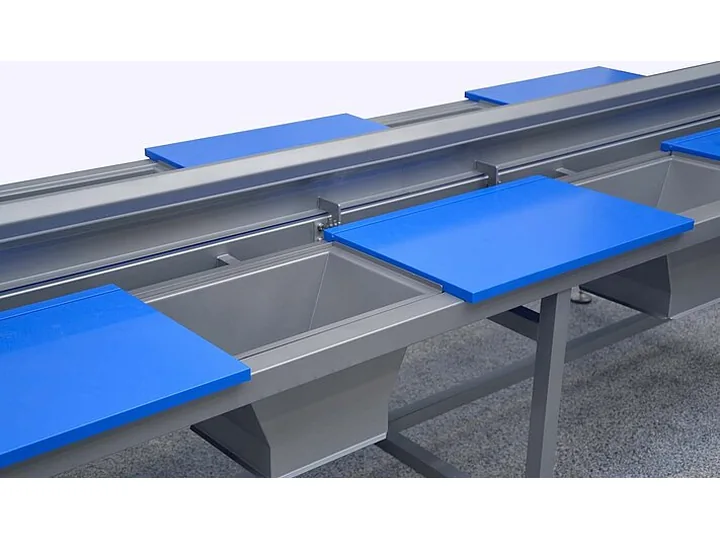
Separate outer-leaf preparation from coring
A supported work surface gives operators room to remove unwanted outer leaves, inspect the head and collect waste separately. This manual table is not an automatic peeler or a core-removal machine.
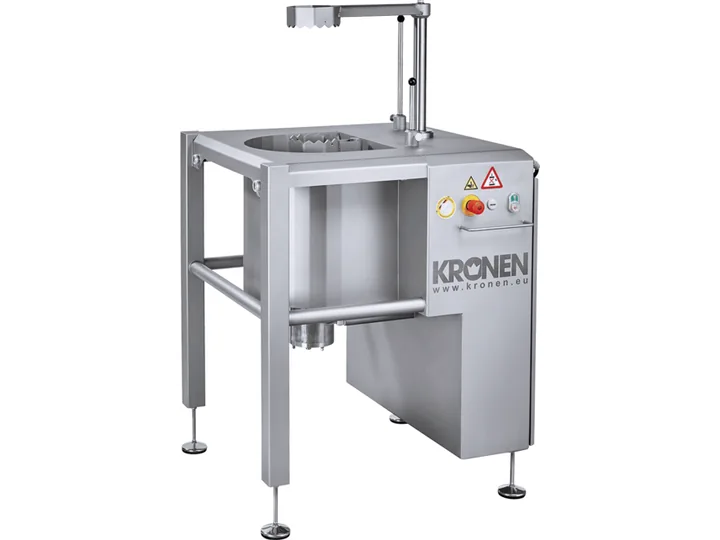
A dedicated station removes the dense core
KSB-2 is a dedicated cabbage corer. Its adjustable coring depth, tool stroke and available tool sizes answer a different requirement from merely splitting the head. Specify the core-removal standard and inspect both the retained head and the removed material in a trial.
Set an outer-leaf standard before comparing corers. Specify damaged material, the base trim and the dense core that may remain in the finished product. For whole heads or retained wedges, check the required structure; for loose ingredients, inspect hard fragments that could pass into the next cutter.
Compare manual preparation, a dedicated corer and an integrated coring/dividing system against the same sample brief. KSB-2 is a separate coring station; KRONEN also describes manual, pneumatic and automated alternatives in its cabbage-processing overview. A photograph does not determine the right automation level for your operation.
In the trial: inspect core-removal consistency across head sizes, useful yield, retained hard material, waste separation and the connection to cutting. Include tool changes, cleaning access and supplier-approved guarding/training. The film illustrates the arrangement and is not a safe-operation or maintenance procedure.
Cutting: specify wedges, strip thickness and strip length
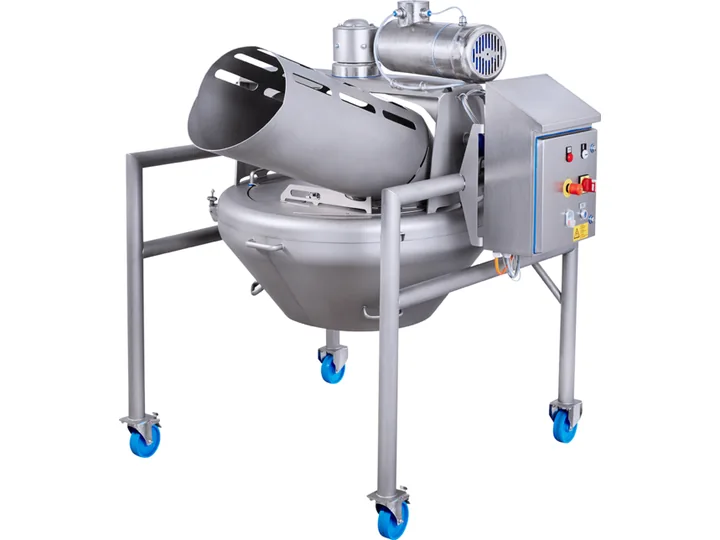
A cabbage shredder controls strip formation
CAP 350 is a current cabbage strip-cutting model. Cutting disks determine thickness, while optional shred shorteners address strip length. Thickness and length are separate dimensions; a quoted strip thickness does not describe the complete finished cut.
Strips and shreds: CAP 350 is a cabbage-specific reference for cutting heads into strips. Agree the supplied disk, cut thickness and any shred-shortening arrangement separately. Check the inlet against your head-size range and whether preparation is required before feeding.
Wedges or larger pieces: specify a dividing or belt-cutting arrangement for that output. A strip cutter does not automatically make uniform wedges or dice. Supply drawings and samples showing the permitted core, rib and leaf result.
Inspect long strings, fines, crushed ribs, torn leaves and variation between the beginning and end of a head. Repeat the assessment after washing and dewatering. The older CAP 68 and current CAP 350 are identified separately below; a predecessor's film is not used as evidence of every current feature.
Washing: distinguish outer surfaces from prepared leaves
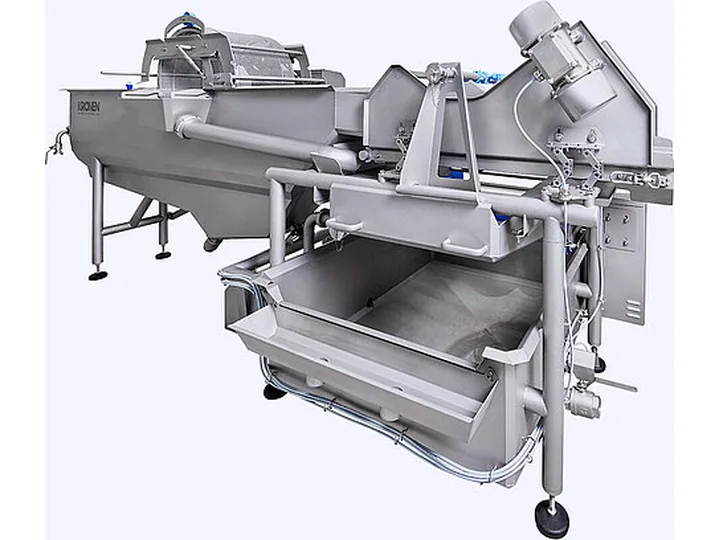
Choose the outfeed for the prepared product
KRONEN identifies HEWA washing machines in its cabbage-processing route. HEWA 3800 offers vibration or belt outfeed arrangements. Confirm the offered setup for your strips or pieces; a general whole-vegetable listing does not establish washing between the retained leaves of an intact cabbage.
Whole heads need an explicit cleaning and drainage brief. Do not assume the inner retained leaves receive the same treatment as the exposed surface. For wedges or loose strips, agree the sequence of pre-cleaning, cutting, washing and inspection with the process team.
For the cut-product washer, compare product distribution, floating and sinking fractions, agitation, outfeed and fine-material loss. Specify screens, debris removal, the water circuit, drainability and cleaning access. Trial white and red cabbage separately where both are required rather than assuming identical behaviour.
The HEWA reference explains a washing duty, not a ready-to-eat result. No universal water temperature, chemical concentration, contact time or microbial-reduction claim is prescribed here. Agree the acceptance method for the actual process and intended use.
Sorting: use the right inspection point for the product
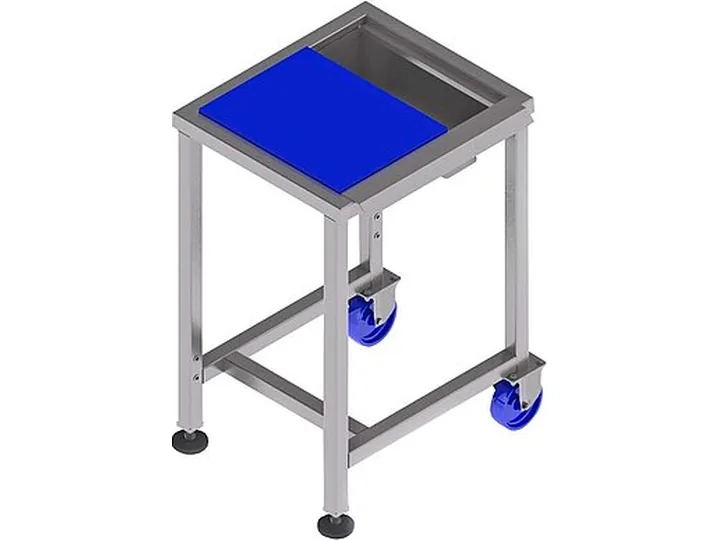
Keep quality selection visible and reachable
This is another arrangement in the preparation-workstation family. It illustrates manual selection, turning and separation of unwanted material. It is not an optical sorter, an automatic head-weight grader or proof of inspection inside a closed head.
Heads and wedges: define size, visible condition, trim, core and presentation. Provide room to turn the product, examine cut faces and move rejected material away. If weight grading is required, specify weighing and lane separation as distinct functions.
Shredded product: define the unwanted material and acceptable variation before selecting manual inspection or a proposed optical system. Wet overlapping strips and dense rib pieces must be presented appropriately. Separating by size is not the same as detecting quality defects.
Require a supplier-confirmed challenge trial for any automatic detection claim, including missed defects and accepted-product loss. The workstation shown is manual; no inside-head inspection, optical detection accuracy or universal foreign-material removal is inferred.
Dewatering: match free-water removal to the cut
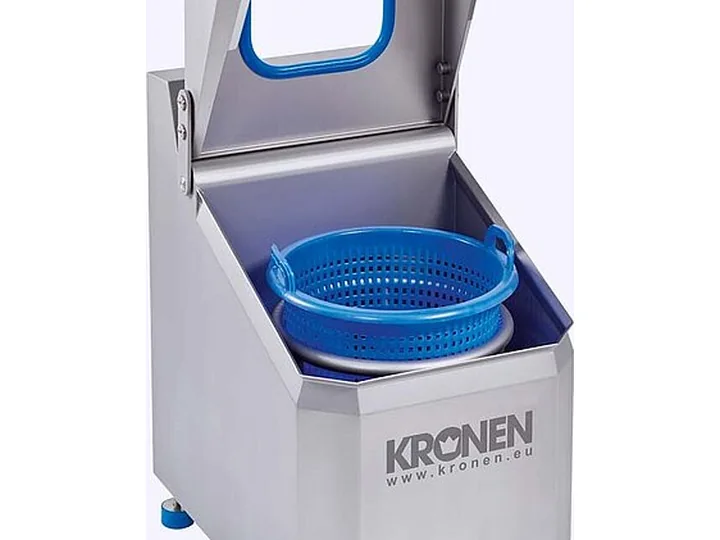
Judge dewatering with the actual cabbage cut
A basket centrifuge is a batch water-removal reference for a supplier-confirmed leaf or cut-vegetable product. Match loading and basket openings to the cut. The photograph does not establish intact-head suitability or an optimum cabbage cycle.
Drain-down and the transfer from washing are part of the specification. For a basket spinner, compare loading consistency, openings, cycle, unloading and handling effort with your real cabbage cut. Connected centrifugal or air systems may be proposed for a continuous line, but require their own confirmed configuration.
| Product form | Handling to compare | Acceptance checks |
|---|---|---|
| Whole heads or retained wedges | Supported drainage and any specifically confirmed air treatment. | Water among layers, retained structure, bruising and condition after holding. |
| Long shreds or strips | Configured basket or connected water-removal route. | Clumping, broken strips, uneven loading, remaining free water and unloading. |
| Shortened shreds or pieces | Matched drainage and centrifugal arrangement with suitable openings. | Fines loss, rib/leaf separation, carry-over water and downstream dosing. |
Agree a repeatable remaining-water assessment and inspect the product after a realistic hold. Do not infer whole-head compatibility from a salad-spinner image, or copy one speed and cycle across all cuts. Dewatering is not cooking, sterilisation or proof of shelf life.
Packaging: protect the product and keep the seal clear
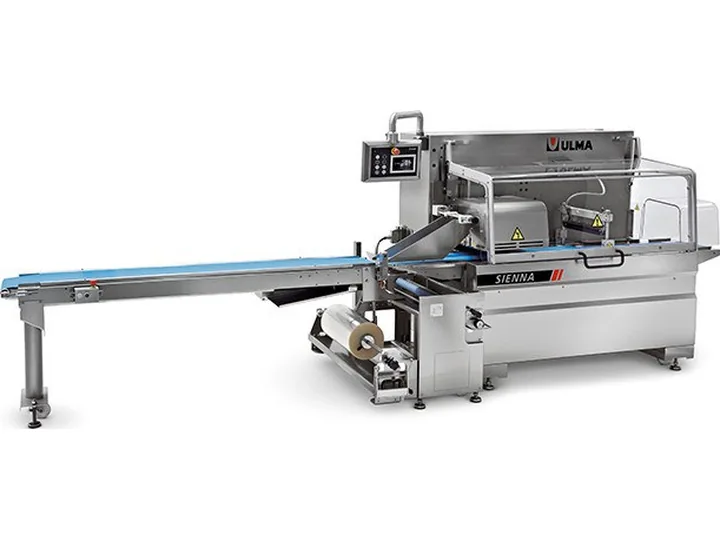
Support the head or portion through the wrapper
SIENNA is a produce-capable horizontal wrapper family. It provides a format reference for whole heads or retained portions, not a verified cabbage configuration. Establish product dimensions, film, support and sealing clearance with the actual head or wedge.
Whole heads and portions: compare the specified sleeve, bag, tray, flow wrap or shipping container. Check support, head or wedge dimensions, cut-face presentation, film clearance, transport protection and coding. The SIENNA picture is a general produce-family reference; confirm cabbage compatibility and the offered options with samples.
Loose strips and pieces: specify weighing/dosing, settling, pack geometry and the handoff from dewatering. Test bridging, compression, weight variation, strips crossing the seal, remaining water, leaks and rejected packs. A bagging machine alone does not solve irregular product feeding.
If MAP is required, obtain a specification for gas handling, film and the complete distribution process. Standard wrapping does not establish MAP capability. No gas recipe or shelf-life promise follows from these equipment images.
Watch coring and current-model strip cutting separately
The first official film explains dedicated core handling; the second identifies the current strip cutter. Both provide motion and product-transfer context beyond the photographs, with original English viewing notes.
1. Understand the dedicated coring station
KRONEN's KSB-2 film shows a cabbage positioned in the coring station and the machine's head-support arrangement. It helps explain why core removal needs its own tooling and acceptance standard.
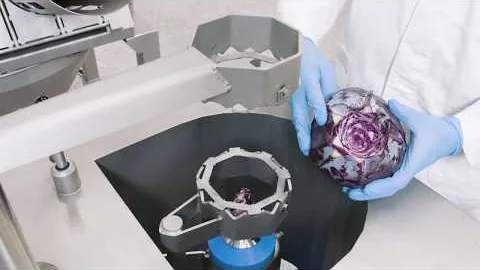 Watch on YouTube ↗ · 2:27
KRONEN Food processing · Official manufacturer footage
- Around 0:30: inspect how the head is supported at the coring position. Ask how your head-size variation and required cavity relate to the offered tooling.
- Around 0:50: the operator handles a circular support component. Include tool and support changes in the supplier demonstration; the scene is not a maintenance instruction.
This older film also shows the CAP 68, the predecessor of CAP 350. Do not identify that cutter as CAP 350. The current KSB-2 design and accessories may differ from the filmed version. Music and limited technical captions make the English notes useful; no advertised output or safety result is inferred.
2. Follow the current CAP 350 strip-cutting route
This separate official film identifies CAP 350 rather than its predecessor. Compare the feed arrangement and outgoing strips with the coring duty above. The film is a model demonstration, not a guaranteed cut result for every cabbage variety.
 Watch on YouTube ↗ · 1:20
KRONEN Food processing · Official manufacturer footage
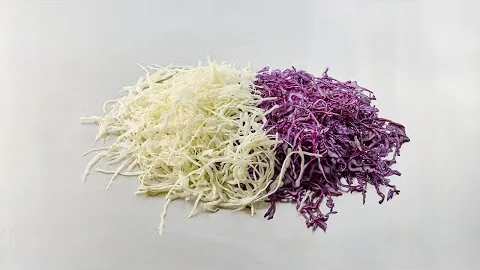
- Around 0:20: observe red-cabbage strips leaving the lower discharge. Specify a suitable receiving conveyor or food-contact container for a production layout.
- Around 1:00: the cutter is open for rinsing. Ask the supplier to demonstrate approved cleaning access and isolation; do not treat this short scene as a cleaning procedure.
The demonstration lets strips fall onto the floor; this is not a production collection or hygiene practice to copy. Cut geometry, tool choice, core preparation and incoming heads affect the offered process. This supplementary film does not replace a signed specification, guarded-operation training or a measured product trial. Both demonstrations open on the original YouTube channel.
Build a trial brief around your cabbage product
- Describe the incoming heads: type, size range, density, outer-leaf condition, base and realistic variation.
- Provide finished samples: retained whole head or wedge, permitted core, strip thickness/length or piece geometry, and final pack.
- Track useful output: trim and core waste, fines, damaged product, rejected quality, rework and rejected packs.
- Include all connections: supported drops, transfer heights, drainage, buffers, baskets/bins, stops and restart.
- Include practical acceptance: cleaning, water circuits, safe access, tooling, changeover, utilities, training and responsibilities.
Questions before selecting cabbage equipment
Do whole-head packs need core removal?
Not automatically. Specify the retained structure and product standard. Dedicated coring is a separate decision from outer-leaf and base trimming.
Does strip thickness also define strip length?
No. Cutting disks and any shortening arrangement address different dimensions. Request samples with both dimensions recorded.
Does the older video show CAP 350?
No. The KSB-2 combination film includes CAP 68. The separate CAP 350 film identifies the current cutting model.
Can one line specification cover white, red, savoy and napa cabbage?
Do not assume that. Provide actual raw material and finished samples for each required product. Napa cabbage has its own guide, and the equipment configuration must match the intended forms.
Sources, image credits and review scope · 2 November 2026
Images are attributed manufacturer equipment, workstation or process references. Two workstation views show one configurable family; the wrapper is a studio reference and the spinner is a basket detail. No image or film is presented as a Food Machinery IQ factory, installation or completed acceptance trial. Supplier inclusion is permanently free; supplier addresses are plain text.
- KRONEN: KSB-2 cabbage corerhttps://www.kronen.eu/en/solutions/cabbage-corer-ksb-2
- KRONEN: CAP 350 cabbage cutting machinehttps://www.kronen.eu/en/solutions/cap-350-cabbage-cutting-machine
- KRONEN: cabbage preparation and processing routeshttps://www.kronen.eu/en/news/efficient-cabbage-processing-from-the-grid-cutter-to-top-performance
- KRONEN: preparation workstation familyhttps://www.kronen.eu/en/solutions/trimming-table-for-4-people
- KRONEN: HEWA 3800 washing machinehttps://www.kronen.eu/en/solutions/hewa-3800-washing-machine-with-vibration-or-belt-outfeed
- KRONEN: KS-100 PLUS spin-dryerhttps://www.kronen.eu/en/solutions/vegetable-and-lettuce-spin-dryer-ks-100-plus
- ULMA: SIENNA horizontal flow wrapperhttps://www.ulmapackaging.com/en/packaging-machines/flow-pack-hffs/sienna
Model scope and the original official films were checked. Promotional capacity, hygiene, yield and shelf-life claims are not adopted as independently verified results. Current signed specifications and trials with the required cabbage types remain the procurement basis.