Crop guide · Napa cabbage preprocessing
Choose the finished form before choosing the machines
A whole napa head, a clean half and a bag of cut leaves are three different products. Their equipment must handle dense bases, thick white ribs and softer leaf sections without confusing one result with another. This guide covers washing, trimming, cutting, sorting, dewatering and packaging, with real manufacturer references and an official working-line demonstration.
Here, napa cabbage means the heading Chinese cabbage also known as won bok. It is distinct from the open-stalk bok choy covered in its own guide. Supplier catalogues sometimes use the broad term Chinese cabbage; confirm the actual variety, dimensions and finished form before ordering.
Three routes with different handling requirements
Whole-head fresh packs
Receiving and selection → conservative base and outer-leaf trimming → cleaning under the agreed whole-head process → supported draining if washed → final size/quality grouping → protected packing.
Preserve the head. A whole retail head normally bypasses cutting. Confirm the required cleaning process and whether water can leave the retained leaves; a loose-leaf washing line is not automatically a whole-head line.
Halves, quarters or separated leaves
Receiving → trim → split or separate as required → inspect newly exposed areas → wash at the specified points → drain with support → portion and pack, or transfer to another controlled process.
Specify base retention. A half that must stay together needs a different trim from leaves intended to separate. Salting, brining, seasoning and fermentation require their own process specification beyond this equipment guide.
Fresh-cut strips or pieces
Receiving → remove unwanted material → prepare the feed → cut to specification → configured washing and inspection → drain/dewater → weigh and pack.
Specify the rib as well as the leaf. Mixed pieces and separately collected rib/leaf fractions are different outputs. Agree the order of pre-cleaning, cutting and washing with the process team rather than copying another crop's settings.
Trimming: decide what the base must hold together
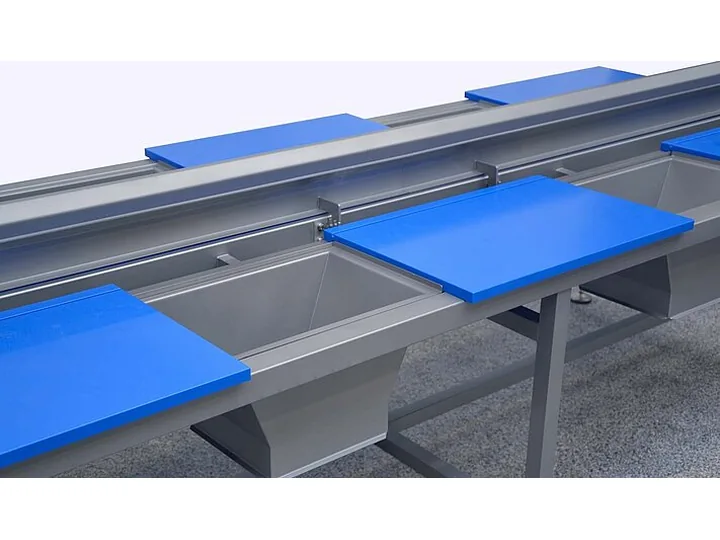
Keep preparation and waste on separate paths
This manual preparation table illustrates supported trimming and a separate discard route. It is not an automatic napa-cabbage corer. Specify whether the base must hold a whole head together or be removed so leaves can separate.
Write down the accepted outer-leaf condition and the position of the base cut. For whole heads, retain the required attachment and shape. For halves or quarters, inspect the exposed centre. For separated leaves or cut ingredients, define how much base and dense rib material can remain.
Compare operator access, head support, knife handling, discard collection and transfer to the next stage. Keep trimming waste separate from accepted product. Where automatic coring or root-end removal is proposed, require a demonstration with elongated napa heads; a machine designed for a round cabbage or iceberg core is not sufficient evidence.
Cutting: separate splitting from size reduction
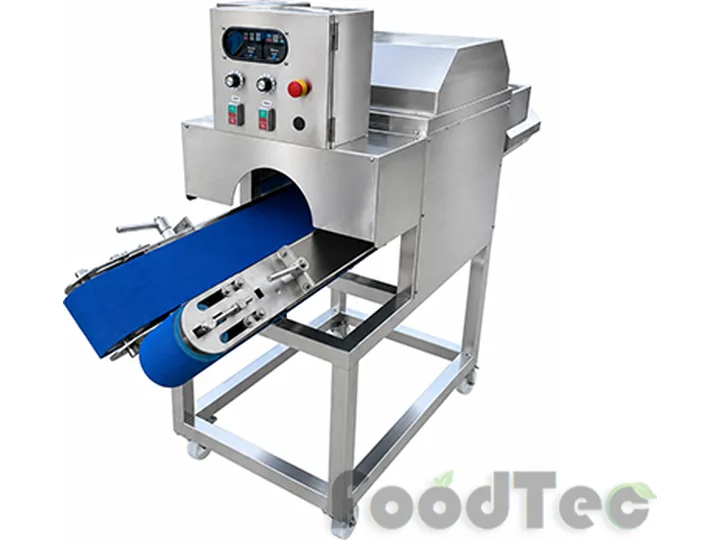
A halving machine makes halves, not shreds
FOODTEC lists Chinese cabbage among the applications for this conveyor-fed circular-blade halver. Its optional infrared positioning feature must be confirmed in the offered configuration. A halving machine does not by itself produce strips, dice or an extracted core.
For halves: establish head orientation and support before the blade, the desired cut line, permitted size range and how both halves leave the machine. The FT-321A is a manufacturer-listed Chinese-cabbage halving reference. No advertised output or dimensional specification is adopted as a result for your napa lot.
For strips or cross-cut pieces: compare a supplier-confirmed belt cutter or other appropriate cutting arrangement. Specify the feed width, whether heads must first be split, the desired rib and leaf dimensions, the blade arrangement and changeover method. A halver is not a substitute for that second duty.
Judge crushed ribs, torn leaves, long uncut pieces, fines and useful output after the complete process. Ask for samples from different incoming head sizes, then check them again after washing, dewatering and pack handling. Do not compare machines using cut length alone.
Washing: whole heads and loose pieces behave differently
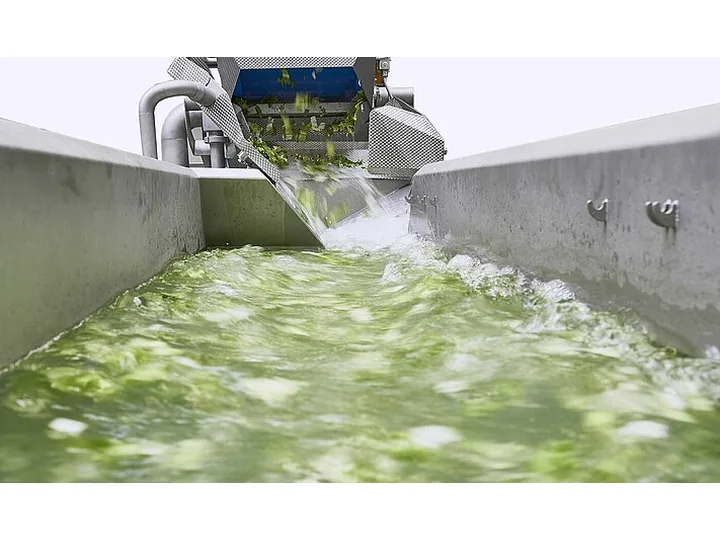
Look inside the washing duty
The photo makes water movement and product presentation visible. KRONEN lists Chinese cabbage within the connected leafy-vegetable line application. Confirm the actual napa product form and washer setup; the illustrated loose greens do not establish cleaning between tightly retained head leaves.
For an intact or partly retained head, make water access and drainage explicit acceptance questions. Inspect the base and retained inner areas in actual samples. Cleaning the visible outer surface does not demonstrate the same result inside the head. For separated leaves or cut pieces, trial distribution, agitation, contact between leaves and the outfeed.
A wash proposal should identify pre-cleaning where required, soil/debris separation, screens, the water circuit, discharge, drainability and access for cleaning. The illustrated GEWA XL wash-tank duty belongs to a connected loose-leaf line; exact napa configuration and operating settings require supplier confirmation.
Measure product condition and the agreed wash outcome instead of adopting a universal chemical concentration, treatment time or water temperature. Machine photographs and a clear-looking water stream do not establish microbial reduction or ready-to-eat status.
Sorting: define defects before buying detection
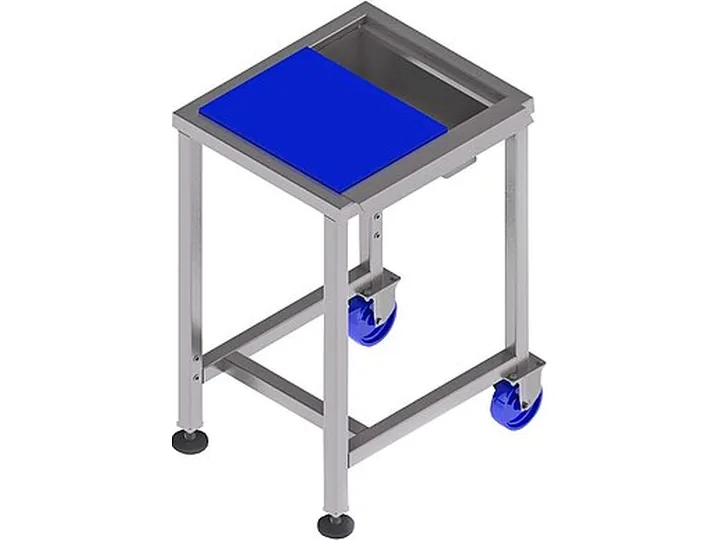
Make the selection point accessible
A manual station supports inspection, turning and separation of unacceptable material. This is another arrangement in the preparation workstation family. It does not measure head weight automatically or demonstrate optical defect rejection.
Whole heads: define acceptable size, weight band if relevant, shape, visible damage and retained leaves. A manual table or inspection conveyor needs room to turn the head and a clear reject path. If weighing and lane separation are required, include them as separate specified functions.
Halves and cut product: inspect exposed areas and the actual outgoing stream at agreed points. Ask how wet pieces, overlapping leaves and dense ribs affect presentation. Separation by size or by leaf/rib fraction does not automatically reject discolouration or foreign material.
If optical or camera sorting is offered, request a napa-specific challenge trial with agreed defect categories and acceptable-product loss. The workstation photograph shows a manual selection arrangement. It does not prove automatic detection accuracy, inspection coverage inside a whole head or an optical grader configuration.
Dewatering: remove free water without losing the product form
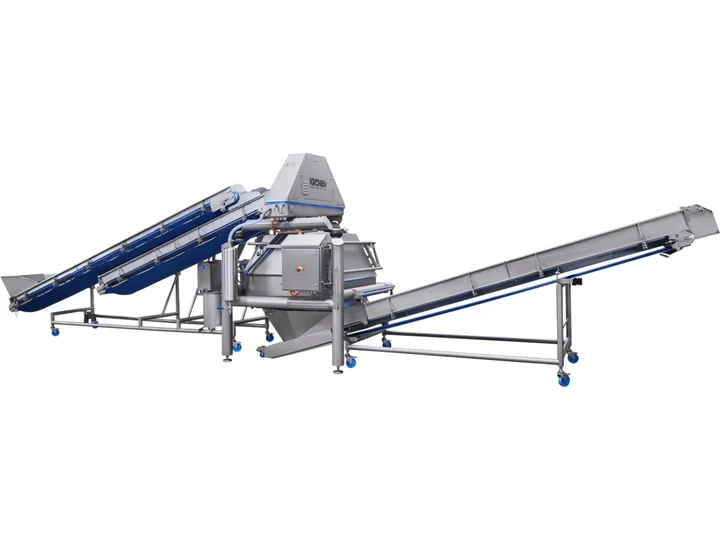
A connected centrifuge is a line-level choice
K850 is the centrifugal drying stage identified in KRONEN's leafy-vegetable line. It illustrates a connected alternative to manually moved baskets. Specify the prepared product, feed pattern, discharge and line controls; do not extrapolate whole-head suitability or a napa throughput from a lettuce example.
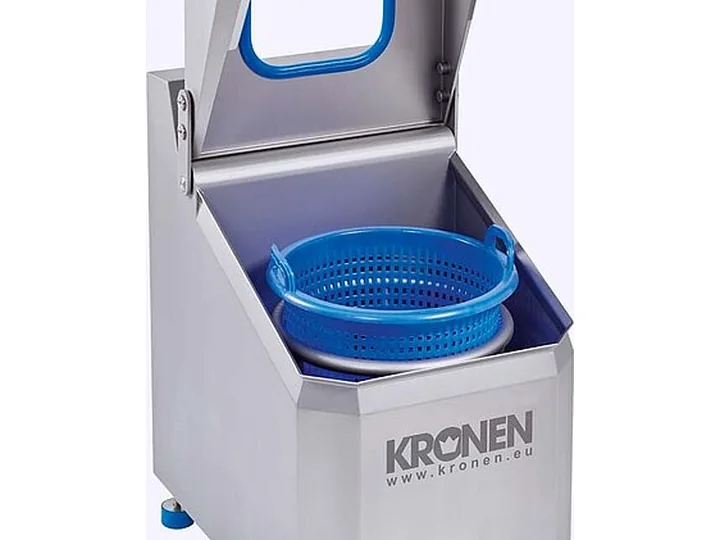
Compare basket handling at smaller batch scale
A basket spinner illustrates batch water removal for a supplier-confirmed loose or cut product. Check loading effort, distribution, fines retention and unloading. An open basket photo does not establish that intact napa heads or large halves can be spun without damage.
Begin with supported drain-down and the product's orientation. For whole heads and retained halves, ask how water leaves the layered structure and how the product reaches the packer. For detached leaves or cut pieces, compare basket centrifugation with a connected drying arrangement, including the transfers before and afterwards.
| Product form | Arrangement to specify | What to check in the trial |
|---|---|---|
| Whole heads or retained halves | Supported drainage; any air treatment or rotation must be supplier-confirmed for that form. | Water between layers, head integrity, bruising and the condition after holding. |
| Separated leaves | A confirmed basket or connected system matched to leaf and rib loading. | Folding, rib breakage, uneven loading, unloading and remaining free water. |
| Cut strips or pieces | Configured draining/centrifugal equipment matched to cut geometry. | Fines loss, clumping, leaf damage, carry-over water and downstream dosing. |
Agree a repeatable free-water assessment and inspect the product after a realistic hold, not just at discharge. Specify controls for interruptions and restart. Neither a salad-spinner photograph nor the K850 family listing establishes intact-head suitability, an optimum speed or a universal cycle.
Packaging: match the head, portion or cut-product flow
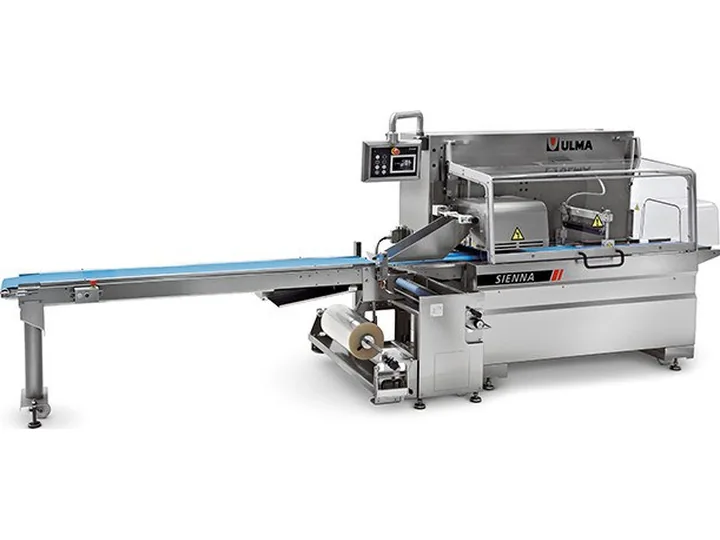
Keep the head supported into the pack
SIENNA is a horizontal flow-wrapper family offered for produce and other foods. It is a packaging-format reference here, not a confirmed napa-cabbage installation. Ask ULMA to establish head or half dimensions, support, sealing clearance and the actual film configuration with samples.
Whole heads and retained halves: compare the specified sleeve, bag, tray, flow wrap or shipping container. Check maximum dimensions, cut-face presentation, head support, film clearance and protection during transport. Confirm the offered wrapper with actual napa samples; the SIENNA reference is a general produce family, not a crop-specific acceptance result.
Loose or cut product: define the weigh/dose system, bag or tray, product settling and the handoff from dewatering. Inspect bridging, leaf compression, ribs trapped across the sealing area, net weight, leaks, coding and rejected packs.
Where MAP is required, obtain a specification for the gas equipment, film, pack geometry and distribution conditions. A standard wrap is not evidence of MAP capability. No gas recipe, shelf-life extension or ready-to-eat claim follows from the equipment shown.
See how a loose-leaf line connects its duties
The official film below clarifies wash-tank geometry, bed depth and transfers, which are hard to judge from isolated machine pictures. It serves the prepared-leaf or cut-product comparison; it is not a demonstration of an intact napa-head washing process.
Follow loose product through washing and transfers
This official KRONEN line film shows the spatial relationship between a wash tank, belts and product discharge. The associated manufacturer page lists Chinese cabbage as an application. The footage shows other leafy products and does not validate intact napa heads or your cut size.
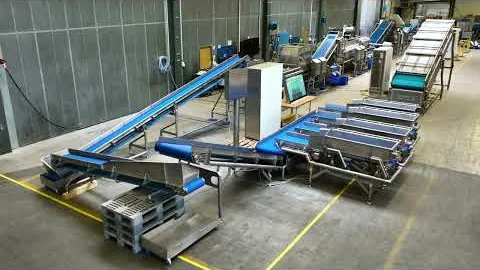 Watch on YouTube ↗ · 8:07
KRONEN Food processing · Official manufacturer footage
- Around 3:02: an overhead view shows loose product in the wash tank and its connection with the adjacent belt. Look at water coverage and the product handoff.
- Around 5:12: follow the spread of cut leafy material along a blue belt. Consider bed depth and accumulation before the next stage.
- Around 6:12: inspect the product on the outgoing blue conveyor between side guides. Include this discharge and its receiving container or packer in the trial brief.
The film dates from about four years before this review. Current model options can differ. English text and speech appear alongside music; the notes above are original viewing observations, not a transcript or a safe operating procedure. No advertised lettuce output, hygiene claim or shelf-life result is transferred to napa cabbage.
Prepare a napa-cabbage trial brief
- Show the incoming variation: head shape and size range, variety, outer-leaf condition, base and realistic delivery history.
- Provide finished samples: whole head, retained half, separated leaf or cut piece; include the trim line, cut face and final pack.
- Follow useful output: measure trim waste, fines, damage, rejected quality, rework and rejected packs across the complete route.
- Specify connections: transfer heights, product support, draining, buffers, baskets or bins, downstream stops and restart.
- Include operation and cleaning: safe access, guards, water circuits, drains, tools, utilities, changeover, acceptance method and responsibilities.
Questions before choosing a line
Does every napa line need a cutter?
No. Whole-head fresh packs normally bypass cutting. Halving, leaf separation and cutting into ingredients are different duties with different base-retention requirements.
Can a loose-leaf washer validate a whole-head process?
No. A whole head needs its own evidence for water access, retained material, drainage and final condition. A prepared-leaf demonstration does not establish those results.
Can whole heads go straight into a salad spinner?
Do not infer that from a loose-leaf machine listing. Require a supplier-confirmed arrangement and sample trial for the exact whole or split form.
Is this also a kimchi production line?
No. This guide explains preprocessing duties. Salting, brining, rinsing where specified, seasoning, fermentation and the downstream pack require their own controlled process and equipment brief.
Sources, image credits and review scope · 2 November 2026
Images are attributed manufacturer equipment, workstation or process references. The two workstation views show one configurable family. The wash-tank photo and official film show other loose leafy products; the wrapper is a studio reference. No reference is presented as a Food Machinery IQ installation or a completed napa-cabbage acceptance trial. Supplier inclusion is permanently free; source addresses are plain text.
- FOODTEC: FT-321A fresh-produce halving machinehttps://www.foodtec.com.tw/product/cutting-machines/fresh-produce-halving-machine-ft-321a
- KRONEN: processing line for salad and leafy vegetableshttps://www.kronen.eu/en/solutions/processing-line-for-salad-and-leafy-vegetables
- KRONEN: configurable preparation workstationhttps://www.kronen.eu/en/solutions/trimming-table-for-4-people
- KRONEN: KS-100 PLUS basket spin-dryerhttps://www.kronen.eu/en/solutions/vegetable-and-lettuce-spin-dryer-ks-100-plus
- ULMA: SIENNA horizontal flow wrapperhttps://www.ulmapackaging.com/en/packaging-machines/flow-pack-hffs/sienna
- Oregon State University: Chinese cabbage and leafy greens identityhttps://horticulture.oregonstate.edu/oregon-vegetables/cabbage-chinese
The manufacturer application listings and film were checked. Promotional output, sanitising and shelf-life claims are not adopted as independently verified results. Crop terminology is cross-checked against Oregon State University; current signed specifications and product trials remain the procurement basis.