Crop guide · Kale preprocessing
Define the leaf and stem you want in the finished pack
Baby kale leaves, trimmed mature leaves and cut cooking ingredients need different handling. This guide follows six duties: washing, trimming and destemming, cutting, sorting, dewatering and packaging. Start with actual incoming leaves and a finished sample, including the amount of stalk or central rib the customer accepts.
The equipment references show what each duty looks like. A manufacturer-documented kale line supports the cutting and centrifugal water-removal choices. The short official film below clarifies end trimming; its limits are stated beside the viewing notes.
Three product forms to specify separately
Intact baby leaves
Receiving and selection → agreed light preparation → configured washing → drainage and gentle water removal → final inspection → controlled dosing and packing.
Keep the required leaf intact. Cutting is usually bypassed for an intact-leaf product. Confirm the accepted small stalks, leaf condition and loading behaviour with the customer and equipment supplier.
Trimmed mature leaves
Receiving → remove ties and unwanted material → trim ends and remove coarse stalk/midrib to specification → inspect the retained leaf → wash → dewater → portion and pack.
Draw the stem-removal boundary. A retained leaf with part of its rib and two leaf sections with the rib removed are different outputs. Whole incoming bunches require their own unpacking and presentation brief.
Cut kale ingredients
Receiving → specified trimming/destemming → prepared feeding → cut to the required shape → agreed washing and inspection → dewater → weigh and pack or transfer to another process.
Describe the rib as well as the leaf. A mixed leaf/stem cooking product differs from a mainly leaf product. Blanching, cooking, freezing and further processing require additional specifications.
Trimming and destemming: separate the end cut from the central rib
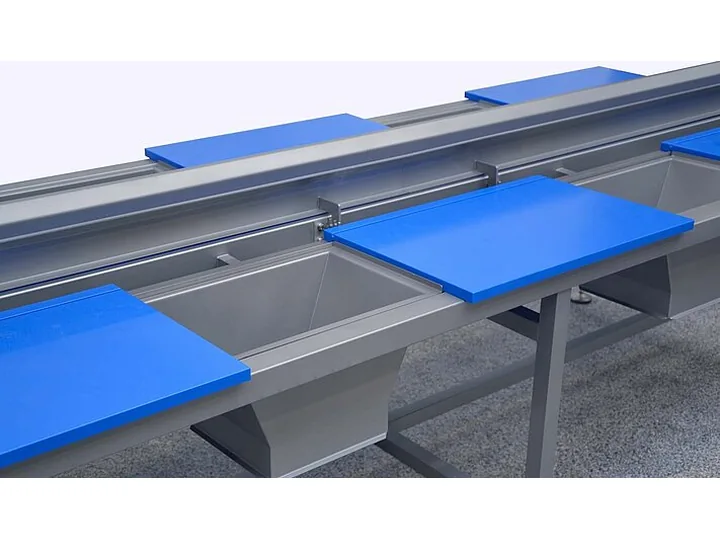
Give stem removal a defined workstation
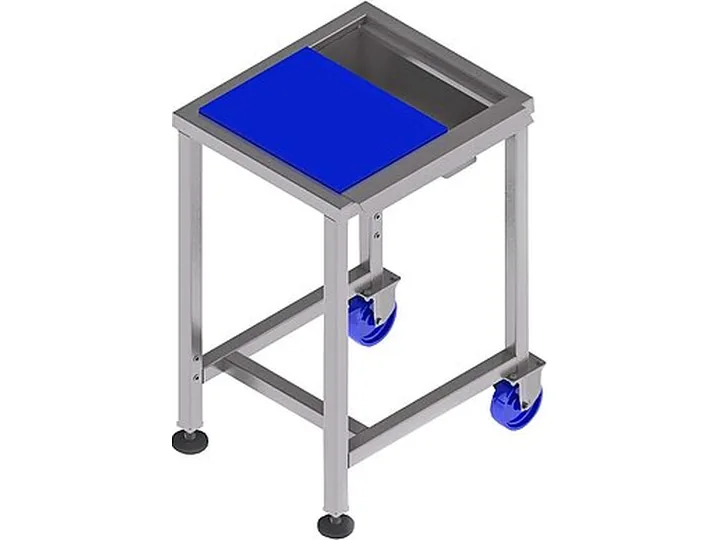
A preparation table supports leaf selection, end trimming and manual removal of unwanted coarse stalk or midrib material. Specify the retained leaf shape and where the discarded material goes. The same work surface can serve different manual tasks; it is not evidence of automatic midrib removal.
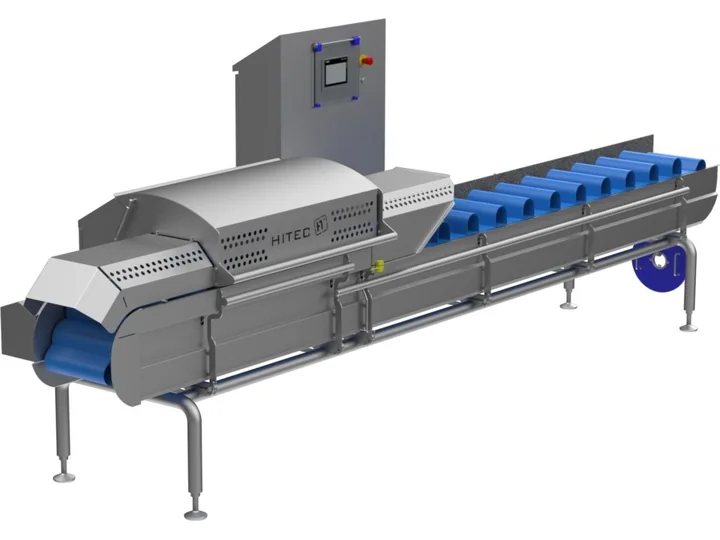
End trimming and leaf destemming are different duties
HiTec lists kale among the applications for TTCS. This is a top/tail trimming reference: discuss product positioning and the required end cut with the supplier. Removing an end is different from stripping a thick central rib along the length of a mature leaf.
End trimming removes the specified stalk end or unwanted tip. Destemming addresses coarse stalk and central rib material retained along a mature leaf. Show both cuts on the finished sample so the supplier can propose the correct work sequence.
For a manual station, compare support, operator reach, knife/tool handling, leaf collection and the discard chute. Check retained rib fragments, leaf tearing and useful output across realistic leaf sizes. The table reference explains that workspace; staffing and yield remain trial results.
If an automatic leaf-stripper or rib-removal module is proposed, request a demonstration with your actual kale and a written retained-leaf standard. The TTCS application listing establishes a trimming reference, not a verified automatic central-rib-removal result. Keep the two duties separate in the quotation.
Cutting: decide whether the product needs strips, pieces or intact leaves
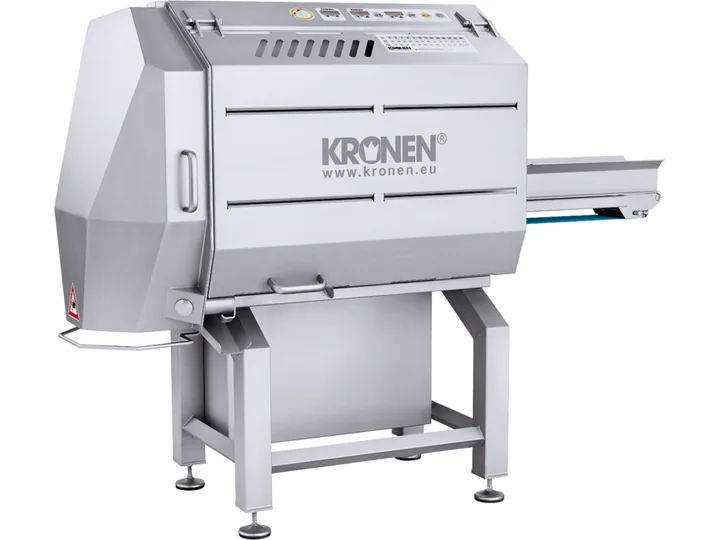
Feed leaves consistently into the cutter
KRONEN's 2021 kale-line report identifies GS 10-2 as the cutting stage. Use that application evidence alongside the current model specification. Agree incoming preparation, leaf spread, tooling and the desired cut; chopping a retained stem does not remove it from the product.
A supplier report from 2021 describes a kale line with a preparation table, GS 10-2 cutter, KS-100 PLUS spin-dryers and downstream packing. It provides application evidence; the current offered tooling and controls still need to match your product.
For prepared leaves, agree the target piece shape, cut dimensions, permitted stalk content and feed presentation. Look for folding, uneven bed depth, long uncut pieces, torn edges and fines. Trial the actual cultivar and maturity rather than treating all kale as the same material.
Inspect the cut again after washing, dewatering and packing. A neat discharge sample alone does not describe the finished pack. For intact baby-leaf products, specify a bypass instead of adding an unnecessary cutting duty.
Washing: present curled leaves and retained ribs consistently
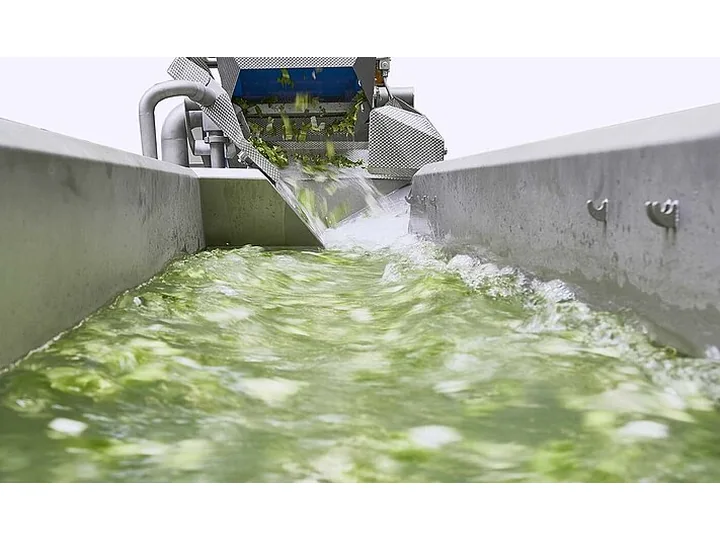
See the product space inside a leaf washer
KRONEN includes kale in its current leafy-vegetable line application, with GEWA washing stages. This image explains the tank and product presentation. It shows other loose greens rather than a measured kale cleaning trial.
Start with the actual product form and incoming soil or debris. Compare how the proposed water movement distributes curled mature leaves, flat leaves and cut pieces, and inspect the areas around retained ribs and folds after the trial.
Specify pre-cleaning where required, debris removal, screens, water management, the outfeed and drainability. Include fine-material loss and the leaf condition after discharge. A wash system must connect sensibly with inspection and dewatering, including stops and restart.
Agree the required cleaning outcome and the method used to assess it. The manufacturer's line references do not supply a universal chemical dose, water temperature, contact time or microbial-reduction result for every kale product. Washing equipment alone does not establish ready-to-eat status.
Sorting: define unwanted material before choosing sensors
Make the quality decision easy to see
An accessible station lets operators turn mature leaves, check retained stalks and collect unacceptable material separately. This is another arrangement within the preparation-workstation family. A proposed camera sorter needs its own kale configuration and challenge trial.
At receiving, define acceptable leaf size, colour, visible damage and unwanted stalks, ties or other material. After preparation, inspect the retained rib and leaf shape. Choose a workstation or conveyor that exposes those features and keeps rejects on a separate path.
For cut kale, agree whether long stem fragments, discoloured material or other specified defects must be removed. Consider wetness, overlap and bed depth when comparing manual inspection with an optical proposal.
A sensor-based system requires a supplier-confirmed kale configuration and a challenge trial covering both missed defects and good-product loss. Cutting stems into smaller pieces and dividing product by size are not substitutes for the required quality selection.
Dewatering: inspect the leaf after loading and unloading
Compare basket loading, drainage and unloading
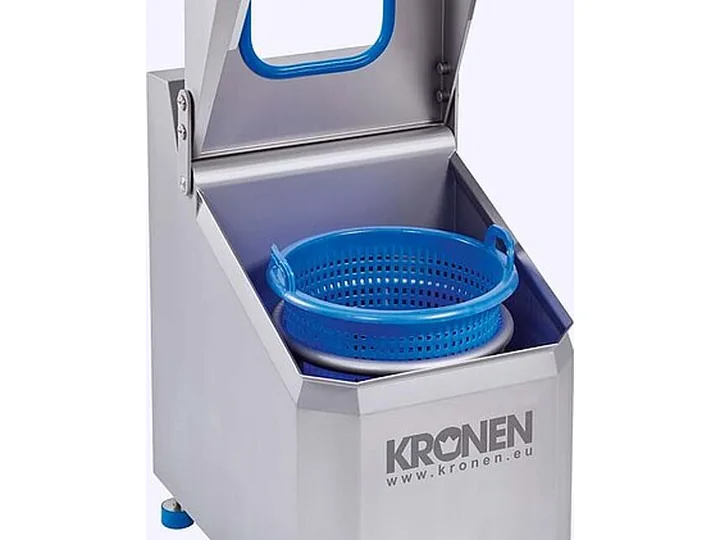
KRONEN's 2021 kale-line report identifies KS-100 PLUS spin-dryers. The basket detail makes loading and removal tangible. Select the actual loading pattern and cycle with the supplier, then inspect free water, leaf damage, clumping and fines loss on your product.
Start with drain-down and the transfer from the washer. For a basket centrifuge, trial the actual leaf form, load distribution, cycle and unloading method. Inspect the product again after a realistic hold so residual free water and clumping become visible.
| Product form | Handling brief | Trial checks |
|---|---|---|
| Intact baby leaves | Controlled loading and a confirmed gentle water-removal route. | Leaf damage, uneven loading, remaining free water and release into the packer. |
| Trimmed mature leaves | Drainage and a system matched to the retained leaf/rib structure. | Folding, retained water, leaf breakage and handling effort. |
| Cut ingredients | Configured basket or connected system with suitable openings. | Fines loss, clumping, stalk/leaf distribution and downstream dosing. |
Compare a basket-based line with any proposed continuous centrifuge or air system using the same finished-product standard. One cycle is not an established setting for every kale leaf or cut. Surface-water removal is separate from thermal drying, cooking and sterilisation.
Packaging: control leaf feeding before judging the bagger
Connect loose-leaf dosing to the chosen bag
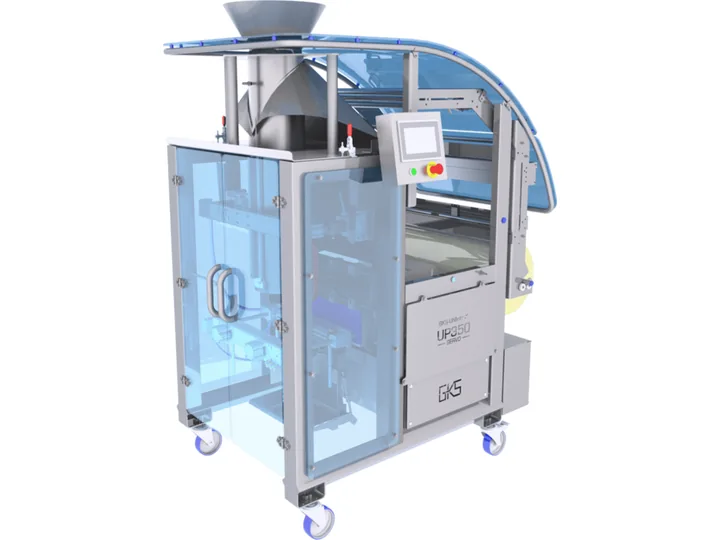
FLEX L is a current bagging-family reference for free-flowing foods and produce. Ask how the proposed weigher and feed system handle your kale leaves or cut pieces. It is separate from the older UP 350 system named in the 2021 case; its exact kale configuration needs confirmation.
Loose leaves and cut product: specify the weigher/doser, drop height, settling and bag or tray geometry. Test bridging, compression, net-weight variation, water in the sealing area, leaves across the jaw, leaks, coding and rejected packs.
Retained bunches or large leaves: compare the required sleeve, bag, tray or supported wrapping route separately. A loose-product bagging reference does not establish bunch presentation or compatibility with every large leaf.
The historical kale case used an UP 350 packaging system. FLEX L is shown as a current configurable bagging-family reference, not as the same model or proof of an identical kale installation. For MAP, obtain a specification for gas handling, film and distribution conditions; no shelf-life promise is inferred here.
Watch an end-trimming layout before specifying destemming
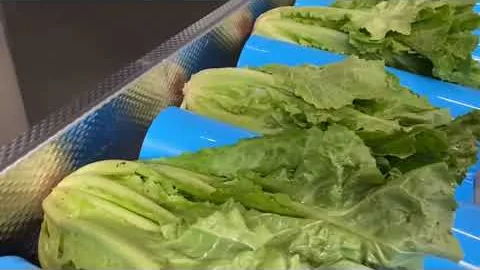
The short film makes the supported feed and working conveyor easy to see. It answers a trimming-layout question; the written guide supplies the separate decisions about retained stems and central ribs.
See the top/tail machine's support and working area
HiTec's official product page links this short demonstration. It shows the TTCS layout and leafy material at the working conveyor. Watch it to understand product presentation before discussing an end-trimming configuration for kale.
 Watch on YouTube ↗ · 0:28
HiTec Food Systems · Official manufacturer footage
- Around 0:08: the overall machine view shows the supported feed, covered working section and exit. Compare these positions with your upstream preparation station.
- Around 0:13–0:18: look at the leafy material against the blue conveyor and its orientation near the working section. Ask what positioning and retained end length your actual kale requires.
The leaf variety in the film was not independently identified as kale. This approximately five-year-old model-family demonstration does not establish removal of a mature kale leaf's central rib. The film has no dependable technical captions; these original English observations provide a text alternative. Current tooling, guards and operating instructions belong in the supplier's offer and training.
Prepare a kale trial brief
- Describe the incoming leaves: cultivar, curled/flat form, maturity, leaf and stalk dimensions, bunches or loose material, and realistic variation.
- Show the retained product: accepted stalk/midrib, trim line, intact or cut form, and final pack sample.
- Follow useful output: stem waste, leaf loss, fines, damage, rejected quality, rework and rejected packs.
- Include the connections: supported drops, transfer heights, draining, baskets, buffers, downstream interruptions and restart.
- Include acceptance and cleaning: water circuits, drains, tool changes, safe access, utilities, training and the agreed checks for each stage.
Questions before choosing kale equipment
Does top/tail trimming remove the central rib?
It addresses an end cut. Removal of coarse rib material along the leaf is a separate duty with its own retained-product specification and trial.
Must intact baby kale be cut?
An intact-leaf product normally bypasses cutting. Confirm the accepted stalks and final pack standard first.
Does the official film prove kale destemming?
No. The manufacturer lists kale as a TTCS trimming application, but the film's leaf variety was not independently confirmed and it does not establish central-rib removal.
Can the 2021 line settings be copied into a new quotation?
Use the report as evidence that a particular processing route was documented. Current raw material, offered equipment, tooling, water management, packing and acceptance results need their own specification.
Sources, image credits and review scope · 2 November 2026
Images are attributed manufacturer equipment, workstation or process references. Two workstation views show one configurable family; the wash-tank photo shows other loose greens, the spinner is a basket detail, and the cutter/bagger are equipment references. None is presented as a Food Machinery IQ installation or a completed kale acceptance trial. Supplier inclusion is permanently free; source addresses are plain text.
- HiTec Food Systems: TTCS top/tail trimming systemhttps://hitecbv.nl/product/hitecttcs/
- KRONEN: documented kale cutting, washing, spinning and packing line, 2021https://www.kronen.eu/fileadmin/user_upload/Inhaltsseiten/Aktuelles/Presseinformationen/2021/Dokumente/Englisch/PressRelease_KRONEN_Specialized_solution_for_kosher_washing_EN_11012021.pdf
- KRONEN: GS 10-2 belt cutting machinehttps://www.kronen.eu/en/solutions/belt-cutting-machine-gs-10-2
- KRONEN: processing line for salad and leafy vegetableshttps://www.kronen.eu/en/solutions/processing-line-for-salad-and-leafy-vegetables
- KRONEN: configurable preparation workstationhttps://www.kronen.eu/en/solutions/trimming-table-for-4-people
- KRONEN: KS-100 PLUS spin-dryerhttps://www.kronen.eu/en/solutions/vegetable-and-lettuce-spin-dryer-ks-100-plus
- KRONEN: FLEX L packaging machinehttps://www.kronen.eu/en/solutions/packaging-machine-flex-l
The official film, current model pages and manufacturer case were checked. The 2021 report is historical application evidence; its certification, hygiene, output and ready-for-use wording is not adopted as an independently verified promise. Current signed specifications and product trials remain the procurement basis.